Add your promotional text...
Lecture 54: The Unforeseen Consequences: A Critical Self-Analysis
Series: The Sahara Reforestation Project: From Dune Sea to Green Valley Part VI: The Anthropocene Redefined - A Thousand-Year Perspective
7/1/20266 min read
Introduction: The Hubris of Creation
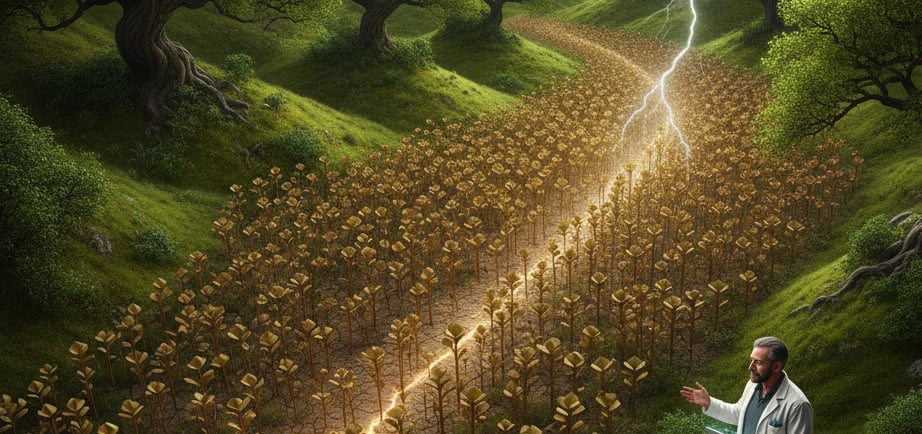
Welcome. For the duration of this series, we have charted a course of profound optimism. We have detailed, with scientific and engineering confidence, a plan to transform a continent, create a new biosphere, and foster a sustainable civilization. Our models are sophisticated, our technologies are powerful, and our intentions are noble. However, history teaches us a humbling and often brutal lesson: every large-scale human intervention in a complex system, no matter how well-intentioned, produces unintended consequences.
The law of unintended consequences is not a mere possibility; it is a statistical certainty. To ignore this would be an act of profound hubris. A project that operates on a planetary scale will inevitably generate planetary-scale side effects, some of which may be benign, others of which could be catastrophic.
This lecture will be an exercise in critical self-analysis and institutionalized skepticism. We will temporarily set aside the triumphant narrative of success and instead explore the "shadow-side" of the Sahara Rosten Project. Our focus will be on a critical review of hypothetical, yet plausible, negative outcomes. We will discuss the risks of ecological blowback, unforeseen climatological feedbacks, and the potential for social and political systems to fail in unexpected ways. The purpose of this lecture is not to argue against the project, but to underscore the absolute necessity of humility, vigilance, and, above all, a framework of adaptive management.
Category I: Ecological Blowback - The Revenge of Complexity
We are designing an ecosystem, but life is not a machine. It is a complex, adaptive, and evolutionary system. Our belief that we can fully control it is an illusion.
The Rise of a "Super-Invasive" Species:
The Scenario: In our effort to select the most robust, fast-growing pioneer species, we may inadvertently create a "monster." A genetically engineered Acacia or Prosopis variety, optimized for drought tolerance and rapid growth, could escape its designated zone and prove to be far more competitive than anticipated. It could begin to aggressively outcompete other species, reducing biodiversity and transforming our carefully designed landscape mosaic into a vast, sterile monoculture.
The Consequence: This would be a "green desert" in a new form—ecologically impoverished and highly vulnerable to a single disease or pest. Eradicating such a species across millions of square kilometers would be practically impossible.
The Emergence of a Novel Pathogen:
The Scenario: By bringing together a novel combination of plants, animals, and microbes from different parts of the world into a new environment, we are creating a perfect evolutionary laboratory for pathogens. A native, harmless fungus could jump to one of our introduced crop species with devastating effect. Alternatively, a seemingly benign microbe in our soil consortium could evolve a pathogenic strain.
The Consequence: A fast-spreading blight or disease could wipe out a keystone tree species or a staple crop, leading to ecological collapse in one region and a potential food security crisis. The genetic uniformity of some of our high-performance cultivars could make them particularly vulnerable.
Trophic Cascade Failure:
The Scenario: Our predator-prey models are based on Earth ecosystems, but the Martian environment is unique. A seemingly small change—say, lower gravity affecting predator agility or a trace element in the soil bioaccumulating in the food chain—could cause a predator population (like the reintroduced cheetahs) to collapse unexpectedly.
The Consequence: With the "landscape of fear" removed, the herbivore populations could explode, leading to rapid overgrazing and the destruction of the very savanna we created before we can intervene. The trophic cascade we so carefully constructed could unravel from the top down.
Category II: Unforeseen Climatological and Geophysical Feedbacks
We are deliberately altering the climate, but the Earth system is notoriously non-linear. Small inputs can have massive, unpredictable outputs.
The "Green Sahara Pump" Overshoots:
The Scenario: Our climate models predict that the biotic pump will reactivate the West African Monsoon. But what if our models are too conservative? The new forest, supercharged with genetically optimized transpiration rates, might create a biotic pump that is far more powerful than the one that existed during the last African Humid Period.
The Consequence: This could lead to a catastrophic "overshoot," pulling too much moisture from the Atlantic and the Mediterranean. Southern Europe could be plunged into a permanent, multi-century drought far worse than predicted. The Sahel, instead of receiving gentle, life-giving rains, could be subjected to decade after decade of extreme, erosive flooding, destroying the very agriculture we sought to support.
The Dust-Pump Shutdown Backfires:
The Scenario: Our mitigation strategy for the "Great Filter of Dust" involves fertilizing the Atlantic with iron. But our understanding of marine biogeochemistry is incomplete. We might trigger the wrong kind of phytoplankton bloom—perhaps a bloom of toxic dinoflagellates instead of benign diatoms.
The Consequence: This could create vast, anoxic "dead zones" in the Atlantic, lead to mass fish kills, and release potent greenhouse gases like methane and nitrous oxide from the decaying biomass, partially negating the project's climate benefits. Our "solution" could be worse than the original problem.
Unforeseen Geophysical Consequences:
The Scenario: The sheer weight of the new Saharan lakes and the water saturating the deep soils (increasing the mass of the continental crust) could have unintended geophysical effects. This "hydro-isostasy" could trigger low-level seismic activity (earthquakes) along ancient, dormant fault lines, such as the East African Rift Valley.
The Consequence: While unlikely to be catastrophic on a planetary scale, this could pose a significant and entirely unpredicted risk to the project's infrastructure (pipelines, dams, cities).
Category III: The Failure of Social and Political Systems
The most complex system of all is the human one. The social and political structures we have designed are logical, but they are not immune to failure, corruption, or human nature.
The "Fall" of the Terraforming Guild:
The Scenario: We envisioned the Guild as a wise, apolitical, multi-generational order of scientific stewards. But what if, over centuries, it becomes something else? It could become a rigid, dogmatic bureaucracy, incapable of adapting to new scientific knowledge. It could become secretive and elitist, losing the trust of the population. Or, it could become corrupt, using its absolute control over the biosphere to enrich itself or exert political power.
The Consequence: A corrupt or incompetent Guild could make catastrophic mismanagement decisions, leading to ecological decline. A conflict between a tyrannical Guild and a rebellious populace could plunge the new Sahara into civil war, with the biosphere itself as the battlefield.
The Resource War:
The Scenario: Our legal framework of usufruct and water markets is designed to be equitable. But a powerful, wealthy faction—a corporation or a new political elite—could, through legal maneuvering or outright corruption, consolidate control over the water rights for an entire river basin.
The Consequence: This faction could then hold downstream cities and agricultural cooperatives hostage, creating a new form of "water feudalism." This would lead to massive social inequality and conflict, undermining the entire social contract of the project.
The Failure of International Governance:
The Scenario: The International Oversight Council, designed to manage the project's external impacts, becomes deadlocked by geopolitical rivalries. A nation negatively affected by a climate shift (e.g., a drought-stricken Spain) might veto a crucial project expansion, while the Saharan Authority, prioritizing its own development, proceeds anyway, breaking the treaty.
The Consequence: The collapse of the international legal framework could lead to a new kind of global conflict—"climate wars"—fought not with armies, but with economic sanctions, cyber-attacks on the AI Core, and potentially even attempts to sabotage the project's infrastructure.
The Prime Directive: A Framework for Adaptive Management
The certainty that unforeseen consequences will occur is the single most important reason for embedding a principle of adaptive management into the very DNA of the project. This is a structured, iterative process of "learning by doing."
Acknowledge Uncertainty: The first step is to formally acknowledge that our models are incomplete and our predictions are provisional. The system is managed based on hypotheses, not certainties.
Monitor, Monitor, Monitor: The vast sensor network is not just an operational tool; it is a scientific instrument for detecting deviation from the expected. The project must invest massively in monitoring for "unknown unknowns."
Phased Implementation and Experimentation: As we have discussed, the project must be rolled out in phases. Each phase is treated as a continental-scale experiment. Before expanding, there must be a prolonged period of analysis to see how the system actually responded, not just how we thought it would respond.
Institutionalized Skepticism: The Terraforming Guild must have an internal, high-status "Red Team"—a group whose sole job is to challenge the prevailing assumptions, look for evidence of negative unintended consequences, and model worst-case scenarios.
Reversibility and Off-Ramps: For every major intervention, the project must consider the possibility of reversal. While greening a desert is not easily reversible, key technological components must have "off-ramps." For example, the ocean fertilization program must be designed so that it can be shut down immediately if negative ecological impacts are detected.
Conclusion: The Humility of the Creator
This lecture has served as a necessary and sobering counterpoint to the optimism that drives our project. We are not simply creating a garden; we are tampering with a planetary system of unimaginable complexity. The potential for unforeseen ecological, climatological, and social blowback is not a remote risk; it is a certainty.
To proceed without acknowledging these dangers would be the height of irresponsibility. The success of the Sahara Rosten Project, therefore, depends not just on the power of our technology, but on the depth of our humility. It depends on our ability to build institutions that are not just powerful, but wise; not just efficient, but cautious.
The framework of adaptive management, with its commitment to monitoring, learning, and institutionalized self-criticism, is the only viable path forward. We must accept that we will make mistakes. The ultimate measure of our success will not be in avoiding all unforeseen consequences, but in our ability to detect them early, to learn from them honestly, and to adapt our course with the wisdom and humility befitting a species that has taken upon itself the role of a planetary creator. Thank you.