Add your promotional text...
Lecture 55: A Mirror to the Past: Lessons from Earth's Great Engineering Projects
Series: The Sahara Reforestation Project: From Dune Sea to Green Valley Part VI: The Anthropocene Redefined - A Thousand-Year Perspective
7/3/20266 min read
Introduction: Standing on the Shoulders of Giants and on the Graves of Follies
Welcome. The Sahara Rosten Project, in its scale and ambition, often feels unprecedented, as if it has no historical analogue. We are, after all, proposing the terraforming of a continent. However, to believe we are the first to undertake geo-engineering on a massive, landscape-altering scale is to suffer from a form of historical amnesia. Throughout history, human civilizations have attempted to re-shape their environment to suit their needs, creating colossal works of engineering that have defined nations, altered ecosystems, and left legacies that have endured for centuries.
These past mega-projects are not mere historical curiosities; they are invaluable case studies. They are a mirror to our own endeavor, reflecting both the heights of human ingenuity and the depths of our hubris and short-sightedness. By studying their successes and, more importantly, their failures, we can distill critical lessons in project management, environmental impact, social consequence, and the nature of long-term success.
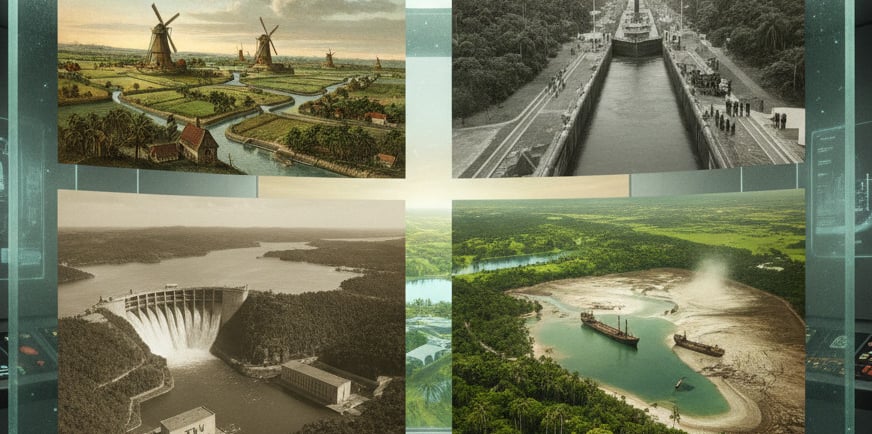
This lecture will conduct a historical and comparative analysis of the Sahara Rosten Project against a selection of Earth's great engineering endeavors. We will examine the Dutch Polder system, a centuries-long battle against the sea; the Panama Canal, a triumph of logistics and medicine; and the Tennessee Valley Authority, a project of integrated regional development. We will also touch upon cautionary tales like the Aral Sea disaster. From these, we will derive a set of guiding principles and warnings for our own, far grander, undertaking.
Lesson I: The Dutch Polders - The Virtue of Incrementalism and Perpetual Maintenance
For nearly a thousand years, the Dutch have engaged in a continuous battle to reclaim land from the sea, creating the vast, intricate landscape of polders, dikes, and canals that defines their nation. The Dutch experience offers our most profound lesson in long-term, incremental geo-engineering.
The Project: The creation of polders involves enclosing a section of a sea or lake with a dike, pumping the water out, and managing the water table in the newly reclaimed land for agriculture and settlement. It is a process of creating habitable land where there was once water.
The Lesson of Incrementalism: The Netherlands was not reclaimed in a single, grand project. It was the result of countless small, local projects, gradually scaled up over centuries. Each success provided the knowledge and economic foundation for the next. This iterative, modular approach allowed for learning, adaptation, and the correction of mistakes on a manageable scale before they could become catastrophic. For the Sahara: This validates our phased approach, where we green the desert in large but discrete, manageable blocks, analyzing the results of each phase before proceeding to the next.
The Lesson of Perpetual Maintenance: The Dutch proverb, "God created the world, but the Dutch created the Netherlands," is incomplete. The full truth is that the Dutch must re-create the Netherlands every single day. The dikes require constant monitoring, the pumps require perpetual power, and the canals require dredging. The system is not a "build-and-forget" project; it is a permanent, multi-generational commitment to maintenance and vigilance. For the Sahara: This is a sobering and vital lesson. Our water grid, our AI management systems, and our managed ecosystems will require a similar, perpetual commitment. The establishment of the "Terraforming Guild" is a direct institutional response to this imperative of perpetual stewardship.
Lesson II: The Panama Canal - The Primacy of Biology and Logistics
The construction of the Panama Canal was one of the great engineering feats of the early 20th century, but its success was as much a biological and logistical triumph as a geological one.
The Project: The creation of a 77-kilometer waterway across the Isthmus of Panama, connecting the Atlantic and Pacific Oceans, involving the excavation of mountains and the creation of the world's largest artificial lake at the time.
The Lesson of Biology: The initial French attempt in the 1880s was a catastrophic failure, not primarily due to engineering challenges, but due to disease. Tens of thousands of workers died from malaria and yellow fever. The American success was predicated on a radical public health campaign led by Dr. William Gorgas, who correctly identified the mosquito as the vector and waged a systematic war to eradicate its breeding grounds. For the Sahara: This teaches us that the most significant threats to a mega-project are not always the most obvious ones. Our success depends not just on our ability to manage the visible landscape, but on our ability to manage the invisible world of microbes, pathogens, and potential blights. It validates our focus on a robust ecological monitoring system and the study of potential novel pathogens.
The Lesson of Logistics: The American effort was a masterpiece of logistics, involving the movement and management of vast quantities of material, machinery, and a massive workforce. It required the invention of new management techniques and an unprecedented level of planning. For the Sahara: The logistical challenge of our project—transporting biomass for compost, distributing seedlings, maintaining a continental sensor network—will be orders of magnitude greater. This underscores the absolute necessity of an AI-powered logistical core, capable of managing and optimizing these continental supply chains with ruthless efficiency.
Lesson III: The Tennessee Valley Authority (TVA) - The Power of Integrated, Multi-Purpose Design
Established in the 1930s during the Great Depression, the TVA was a federally-owned corporation tasked with the comprehensive development of the Tennessee River basin, a region plagued by flooding, deforestation, and poverty.
The Project: The TVA built a system of dams to control flooding, generate hydroelectric power, and improve river navigation. But its mandate was far broader.
The Lesson of Integrated Development: The TVA was not just an energy or flood-control project. It was a holistic regional development authority. The cheap electricity from its dams powered new industries. It ran programs to combat soil erosion, replant forests, and teach farmers modern agricultural techniques. It was a social and economic project as much as an engineering one. For the Sahara: This is the direct historical precedent for the Saharan Authority. It validates our approach of not just building an ecosystem, but building a society and an economy in tandem. The integration of agriculture, energy production, education (via the SAU), and new city planning into a single, unified strategy is a direct application of the TVA's core philosophy. The goal is not just a green desert, but a prosperous and equitable society.
Lesson IV: The Aral Sea - The Cautionary Tale of Unforeseen Ecological Collapse
Not all mega-projects are successes. The destruction of the Aral Sea is perhaps the 20th century's most profound example of a well-intentioned engineering project leading to catastrophic, unforeseen ecological collapse.
The Project: In the 1960s, the Soviet Union diverted the two great rivers that fed the Aral Sea, the Amu Darya and the Syr Darya, to irrigate vast new cotton and wheat fields in the deserts of Central Asia.
The Unforeseen (or Ignored) Consequence: Starved of its inflow, the Aral Sea, once the fourth-largest lake in the world, began to shrink. Over the course of a few decades, it lost over 90% of its volume, leaving behind a toxic, salt-encrusted desert. This led to the collapse of a thriving fishing industry, the devastation of the regional climate (hotter summers, colder winters), and the creation of toxic dust storms that caused widespread public health problems.
The Lesson of System Blindness: The Soviet engineers focused on a single metric: maximizing agricultural output. They treated the river water as a simple input for their irrigation equation and viewed the Aral Sea itself as an external, irrelevant factor—or simply as "evaporation to be corrected." They failed to see the system as an interconnected whole, where the health of the sea was inextricably linked to the health of the entire region. For the Sahara: This is the most terrifying and important lesson of all. It is a stark warning against the dangers of "system blindness." It validates our obsession with modeling global teleconnections, like the "Great Filter of Dust." The Aral Sea disaster is the ghost that must haunt every meeting of the Saharan Authority's council, a permanent reminder that the consequences of ignoring a critical ecosystem component can be swift, total, and irreversible.
Conclusion: A Synthesis of Historical Wisdom
The Sahara Rosten Project does not begin in a vacuum. It begins with the accumulated wisdom, and the scars, of humanity's past attempts to re-engineer the Earth.
From the Dutch Polders, we learn the necessity of an incremental approach and the profound, non-negotiable commitment to perpetual maintenance.
From the Panama Canal, we learn that the invisible world of biology can be more formidable than any mountain, and that logistical mastery is a prerequisite for success.
From the Tennessee Valley Authority, we learn the power of an integrated, holistic vision that seeks to uplift a region in its entirety—ecologically, economically, and socially.
And from the Aral Sea, we learn the terrible price of hubris and system blindness, a lesson that must instill in us a permanent and deep-seated humility.
The Sahara Rosten Project is, in a sense, a synthesis of these historical precedents. It combines the land-creation ambition of the Dutch, the biological and logistical focus of the Canal, and the integrated regional development philosophy of the TVA. And it is designed, from its very core, with the explicit goal of avoiding the catastrophic failures of foresight that doomed the Aral Sea.
By standing on this broad base of historical experience, we arm ourselves with not just the technical knowledge, but the critical wisdom required to undertake our Great Work responsibly.
Our next lectures will continue to explore the long-term, philosophical, and evolutionary implications of this unprecedented endeavor. Thank you.