Add your promotional text...
Lecture 56: The Global Application Model: Greening the Gobi and the Outback
Series: The Sahara Reforestation Project: From Dune Sea to Green Valley Part VI: The Anthropocene Redefined - A Thousand-Year Perspective
7/6/20266 min read

Introduction: The Sahara as a Blueprint
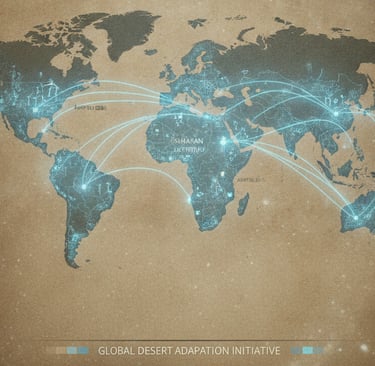
Welcome. Throughout this extensive series, we have treated the Sahara Rosten Project as a singular, monumental endeavor, focused on the unique challenges of North Africa. However, the technologies we've developed, the ecological principles we've codified, and the governance structures we've designed are too powerful and too vital to remain confined to a single continent. The Sahara is not an end in itself; it is a blueprint. It is a planetary-scale pilot project for a new era of proactive ecological restoration.
The arid and semi-arid lands of Earth cover nearly one-third of the planet's land surface and are home to over two billion people. Many of these regions are under increasing threat from desertification due to climate change and human activity. The successful greening of the Sahara provides humanity with a tested and proven model for reversing this trend on a global scale.
This lecture will explore the application of the "Saharan Model" to two of the world's other great arid landmasses: the Gobi Desert of East Asia and the Australian Outback. We will not assume a simple "copy-and-paste" approach. Instead, we will conduct a comparative analysis, detailing how the core principles of the Saharan project must be adapted to the unique geological, climatological, and socio-political contexts of each new region.
The Saharan Model: A Review of Core Principles
Before we can adapt the model, we must first distill its essential, transferable principles:
The Nexus-Driven Approach: The project is managed as a tightly coupled Energy-Water-Food (EWF) nexus, where abundant renewable energy (solar) powers the production of water (desalination/transport), which in turn enables the production of food and biomass.
Integrated Hydrological Engineering: A dual water-sourcing strategy, combining mega-scale coastal desalination with the managed depletion of fossil aquifers, all distributed through a smart, AI-managed grid.
Accelerated Pedogenesis: The rapid, industrial-scale creation of a living soil (technosol) through a combination of microbial inoculation (biocrusts, mycorrhizae) and massive amendments of biochar and compost.
Assisted Ecological Succession: A phased introduction of flora and fauna, starting with hardy pioneers and moving to complex, multi-trophic ecosystems, all guided by principles of landscape ecology (e.g., conservation corridors).
Transnational Governance: The establishment of a dedicated, transnational authority with functional sovereignty over the project, based on principles of ecological stewardship and funded by a diversified portfolio of outputs (food, energy, carbon credits).
It is this five-part strategic framework that we will now seek to apply to new deserts.
Case Study I: The Gobi Desert - A Challenge of Cold and Geopolitics
The Gobi, spanning southern Mongolia and northern China, is a vast desert defined not just by its aridity, but by its extreme continentality and cold.
Unique Environmental Challenges:
Extreme Cold: The Gobi is a cold desert. Winter temperatures can plummet to -40°C. This poses a profound biological challenge, as the plant and microbial palettes selected for the hot Sahara would not survive.
Water Source Limitations: Unlike the Sahara, which is bordered by two major oceans, the Gobi is landlocked. The nearest major body of saltwater is the Bohai Sea, over a thousand kilometers to the east. The potential for desalination is geographically constrained. Fossil aquifers exist, but their scale is less well-understood than the Sahara's.
Different Soil Chemistry: Gobi soils can be rocky and have different mineral compositions, including areas with high gypsum content, requiring a different approach to soil amendment and microbial selection.
Adapting the Saharan Model for the Gobi:
The Water System: The primary water source would have to be long-distance transport. This would involve a colossal pipeline project to bring desalinated water from the Chinese coast westward, a project that would dwarf even the Saharan water grid in linear scale. A secondary strategy would involve tapping the vast amounts of water in Siberian rivers to the north, a project with immense geopolitical implications for Russia, Mongolia, and China.
The Energy System: While solar potential is high in summer, the energy system would need to be adapted for the extreme cold and lower winter sun angle. It would likely require a greater reliance on wind power, which is abundant on the Mongolian plateau, and potentially advanced geothermal or even nuclear power to provide a stable baseload.
The Biological Toolkit: This is where the most significant adaptation is required. We cannot use the Afro-tropical species of the Sahara. The "Greening the Gobi" project would require a completely new biological palette, drawn from the world's cold-arid and steppe ecosystems.
Pioneer Flora: Species would include cold-hardy shrubs like Saxaul (Haloxylon ammodendron), desert poplars (Populus euphratica), and perennial grasses from the Central Asian steppes.
Genetic Engineering: The focus of genetic engineering would shift from heat tolerance to extreme frost tolerance. Genes from arctic and alpine plants would be prime candidates for transfer.
Microbial and Fungal Selection: The entire microbial and mycorrhizal inoculum would need to be composed of psychrophiles (cold-loving organisms).
Governance: The project would primarily be a bilateral endeavor between China and Mongolia. While simpler than the multi-national Saharan Authority, it would require a robust treaty to manage the shared water resources, ecological corridors, and the distribution of economic benefits between the two nations with their very different political and economic systems.
Case Study II: The Australian Outback - A Challenge of Ancient Soils and Unique Biology
The vast arid and semi-arid interior of Australia presents another unique set of challenges.
Unique Environmental Challenges:
Ancient, Nutrient-Depleted Soils: Australian soils are among the oldest and most weathered on Earth. They are profoundly deficient in key nutrients, particularly phosphorus and various micronutrients. The mineral matrix is less reactive than the younger Saharan sands.
Unique, Co-evolved Biota: Australian flora and fauna have evolved in extreme isolation for tens of millions of years, resulting in a unique and highly specialized biosphere (e.g., marsupials, eucalyptus). The introduction of non-native species (even other "arid-adapted" ones from Africa or the Americas) poses an extreme risk of creating invasive ecological disasters.
Erratic, "Boom-and-Bust" Climate: The Outback's climate is dominated by the El Niño-Southern Oscillation (ENSO), leading to extremely long periods of drought punctuated by massive, unpredictable flood events.
Adapting the Saharan Model for the Outback:
The Water System: Australia's geography, a continent-island, is well-suited for mega-scale desalination along its extensive coastline. A national water grid, similar in concept to the Saharan one, would be required to pump this water into the interior. The Bradfield Scheme, a historical proposal to divert Queensland's coastal rivers inland, could also be re-evaluated and integrated.
The Energy System: Australia's solar resources are among the best in the world. A Saharan-style network of CSP and PV plants is a perfect fit to power the desalination and water transport.
The Biological Toolkit: This is the most critical and sensitive adaptation. The project must operate under a strict "Natives First" principle.
Flora: The species palette would be drawn exclusively from Australia's own incredible diversity of xerophytic flora. This includes countless species of Eucalyptus, Acacia (wattles), Triodia (spinifex grasses), and Casuarina. The goal would be to re-establish and expand ecosystems that are authentically Australian.
Genetic Engineering: Genetic enhancement would focus on optimizing native Australian species, not on introducing foreign ones. For example, enhancing the salt tolerance of a river red gum or improving the water use efficiency of a spinifex grass.
Fauna: Reintroduction programs would focus on native marsupial grazers (e.g., certain species of kangaroo and wallaby) and the predators that regulate them (like the dingo). The management of introduced invasive species like feral cats, foxes, and camels would be a primary and ongoing challenge.
Soil Amendment: The challenge of ancient, phosphorus-poor soils is immense. While biochar and compost are still essential for water retention and carbon, the system would require a massive, sustained input of phosphorus fertilizer. This might involve the creation of a new, large-scale phosphorus mining and processing industry or the development of synthetic microbes specifically engineered to unlock phosphorus from recalcitrant mineral forms.
Governance: As the project would largely occur within the borders of a single, stable nation, the governance structure would be simpler than the Sahara's. It could be managed by a new federal agency, a public-private corporation modeled on the Snowy Mountains Scheme, with a strong mandate for consulting and partnering with Indigenous Australian communities, whose traditional ecological knowledge of the Outback is an invaluable resource.
Conclusion: A Global Toolkit for a Hotter, Drier Planet
The Sahara Rosten Project, in its ultimate form, is not just a solution for North Africa; it is the development of a transferable, adaptable toolkit for planetary-scale ecological restoration. By analyzing its application to the Gobi and the Australian Outback, we see both the universality of its core principles and the critical importance of local adaptation.
The nexus of solar energy, desalinated water, and engineered soil is a universal foundation. The technologies of AI-managed grids, microbial inoculation, and genetic engineering are globally applicable. However, the specific biological expression of the new ecosystem—the choice of species, the management of its unique ecology—must be deeply rooted in the local context, honoring the native biogeography and evolutionary history of the region.
The successful greening of the Sahara would provide humanity with more than just a new breadbasket; it would provide a new sense of agency and hope. It would demonstrate that the tide of desertification is not irreversible. It would provide the blueprint for healing the Earth's other great arid lands, transforming the challenges of a hotter, drier 21st century into an opportunity for unprecedented creation and restoration.
Our final lectures will explore the ultimate philosophical implications of this new era of human agency. Thank you.