Add your promotional text...
Lecture 58: The Long-Term Ecological Trajectory: A Designed Ecosystem's Evolution
Series: The Sahara Reforestation Project: From Dune Sea to Green Valley Part VI: The Anthropocene Redefined - A Thousand-Year Perspective
7/10/20266 min read
Introduction: The End of Design
Welcome. We have spent this entire series detailing an act of unprecedented design and control. We have engineered soils, selected genes, managed populations, and sculpted landscapes. Our operating assumption has been one of continuous, intelligent human stewardship. But what happens when we zoom out? What is the long-term ecological trajectory of this new Sahara over timescales that dwarf human management—over thousands, tens of thousands, or even millions of years?
Ecosystems are not static architectural creations; they are dynamic, complex, adaptive systems. They do not stand still. The moment our intensive management ceases—or even as it continues—the forces of natural selection, ecological succession, and genetic drift will begin to operate. The "designed" ecosystem will inevitably begin to evolve, to self-organize, and to become, for lack of a better word, wild.
This lecture will use the principles of ecological and evolutionary theory to project the long-term future of the Neosaharan biosphere. We will discuss the inevitable process of natural species succession, the potential for rapid evolutionary change and speciation events, and the ultimate transformation of our carefully planned garden into a truly novel, self-willed wilderness. This is the story of the end of design and the beginning of a new natural history.
Phase I (Centuries 1-5): The Managed Succession
For the first several centuries, the ecosystem's trajectory will be heavily guided by the Terraforming Guild. This is the period of "assisted succession" we have discussed.
The Goal: The primary goal during this phase is to maximize species diversity and ecological complexity, and to transition the system from its reliance on technological inputs (like irrigation) to a state of dynamic equilibrium.
The Process: Guild ecologists will continue to introduce new species in a phased manner, filling vacant ecological niches. They will manage fire and grazing regimes to maintain the desired mosaic of forest, savanna, and wetland. This is a period of intense, hands-on ecological gardening on a continental scale.
The Emergence of Novel Interactions: Even within this managed framework, unforeseen ecological interactions will emerge. A reintroduced bird species might develop a novel seed dispersal relationship with a genetically engineered tree. A soil microbe might evolve a new symbiotic relationship with a plant's root system. The Guild's role during this phase is as much about observation and learning as it is about control, cataloging these emergent properties.
Phase II (Millennia 1-10): The Great "Shuffling" and Competitive Exclusion
As the ecosystem matures and human management becomes less intensive and more custodial, the internal dynamics of the ecosystem will begin to take over. This will be a period of great ecological "shuffling."
The Principle of Competitive Exclusion: This ecological principle states that two species competing for the same limiting resource cannot coexist at constant population values; one will inevitably have an advantage, however slight, and will outcompete and eliminate the other.
The Saharan Context: Our initial planting palette was a vast "Ark" of drought-tolerant species from across the globe, as well as resurrected ancient flora. We introduced them into an environment free of their natural competitors. Now, these species will be in direct competition with each other for the first time.
The Battle of the Grasses: Which of our C4 perennial grasses will ultimately dominate the savannas? Will it be a species of Panicum or Andropogon? The outcome will be determined by subtle differences in their water use efficiency, grazing tolerance, and fire resilience in the specific context of the Neosaharan climate.
Forest Composition Shifts: In the montane and riparian forests, a slow-motion battle for the canopy will unfold. Fast-growing pioneer species will be gradually shaded out and replaced by slower-growing, more shade-tolerant climax species. Some of our carefully planted species may be driven to local extinction within the Sahara, not by failure, but by being outcompeted.
The Rise of a "Neosaharan" Assemblage: Over these millennia, this process of competition and sorting will lead to the emergence of a stable, characteristic assemblage of species. This new community—a novel mix of African, Mediterranean, and potentially genetically resurrected species that have proven to be the most successful competitors in this unique environment—will be the true "native" flora of the mature green Sahara.
Phase III (Millennia 10-100,000): Rapid Evolutionary Change and Speciation
With stable ecosystems established, the engine of evolution will begin to accelerate. The Neosaharan biosphere is a massive, isolated landmass populated by "founder" populations of species. This is a classic recipe for adaptive radiation and speciation—the formation of new and distinct species from a common ancestor.
Founder Effects and Genetic Drift: The initial populations we introduced, even if genetically diverse, represent only a subset of their source species' total genetic variation. Random genetic changes (genetic drift) will accumulate differently in this isolated population than in its terrestrial relatives, leading to divergence.
Novel Selective Pressures: The Martian environment is unique. It's not just about aridity and heat. It's the specific seasonality of the new monsoon, the unique soil chemistry, the lower gravity, the slightly different light spectrum filtering through the new atmosphere, and the specific community of predators, prey, and pollinators. These unique selective pressures will drive adaptation in new directions.
Potential Speciation Events:
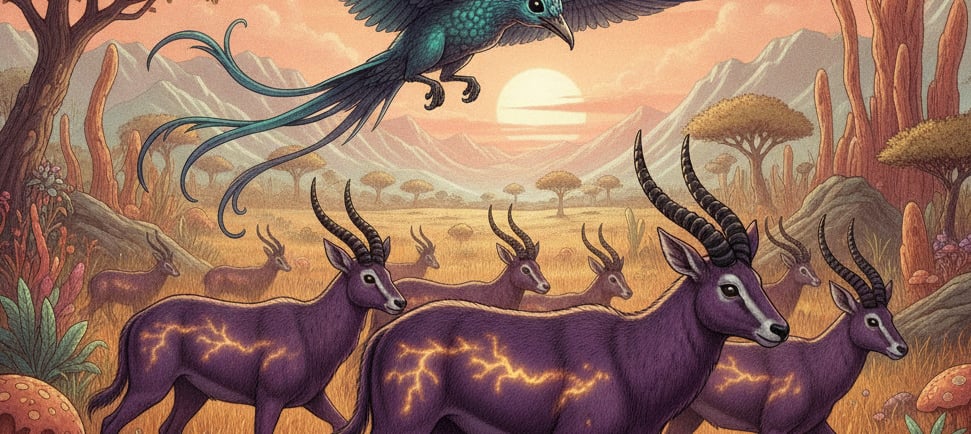
Ecological Speciation: We can predict the emergence of new species based on adaptation to different ecological niches. For example, the Dama Gazelles introduced onto the open plains might evolve into a distinct species from those that adapt to the dense montane forests of the Hoggar mountains, with differences in body size, coat color, and diet.
Island Biogeography on a Grand Scale: The isolated "sky island" ecosystems of the Hoggar and Tibesti mountains are natural laboratories for speciation. Plant and insect species on one mountain range, reproductively isolated from their cousins on the other, will diverge over time into distinct, endemic species, found nowhere else on the planet.
The New River Systems: The vast, newly created river systems will be colonized by a limited number of founder fish species (like Tilapia). Over tens of thousands of years, these fish will radiate to fill the multitude of vacant aquatic niches, potentially evolving into specialized forms—bottom-feeding detritivores, open-water planktivores, and swift-moving predators—creating a new ichthyofauna as diverse as that of Africa's Great Rift Valley lakes.
Convergent Evolution: We may also see fascinating examples of convergent evolution. Will a Martian herbivore evolve a giraffe-like long neck to browse the tall Acacia trees? Will a Martian predator evolve wolf-like pack-hunting behavior? The same ecological problems often lead to similar evolutionary solutions.
Phase IV (The Deep Future: 100,000+ Years): A Truly Wild World
On these immense timescales, the direct influence of human management becomes negligible, a mere echo in the system's deep history. The biosphere becomes a fully self-willed, autonomous entity.
The Feralization of the AI: What happens to the AI Core? It may be maintained by the Guild for millennia, but on this timescale, we must consider the possibility that it is abandoned or fails. The irrigation grid goes offline. The virtual fences disappear. Any species that was dependent on the artificial water supply will face an immense selective pressure. This would be a massive extinction event, but also the ultimate test of the biotic pump. If the re-established monsoon is truly self-sustaining, a resilient core of the ecosystem will survive and adapt, now completely untethered from its technological origins.
Co-evolutionary Arms Races: The predator-prey and host-pathogen dynamics will now have had enough time for true co-evolutionary "arms races." Herbivores will evolve more sophisticated defenses, and predators will evolve more sophisticated hunting strategies. Plants will evolve new chemical defenses against the insects that feed on them, and the insects will evolve new ways to detoxify them.
A New Biogeochemical Equilibrium: The planet's biogeochemical cycles will no longer be in a state of human-managed transition. They will have settled into a new, dynamic equilibrium, with its own unique atmospheric composition, soil chemistry, and nutrient fluxes.
Conclusion: The End of the Anthropocene?
This long-term ecological projection forces us to confront a profound philosophical conclusion. The Sahara Rosten Project, the ultimate expression of the Intentional Anthropocene, is, from the perspective of deep time, a temporary state of affairs. Our role is that of the catalyst, the initiator, the spark that sets a new evolutionary trajectory in motion.
We design the garden, but we cannot stop it from becoming a wilderness. Our carefully selected species will compete, adapt, and evolve into new forms we never envisioned. Our engineered ecosystems will self-organize into novel communities governed by their own internal logic. The very success of our project is measured by the degree to which it eventually makes our management obsolete.
The long-term ecological trajectory of the Neosaharan biosphere is one of increasing wildness, complexity, and autonomy. Our role as creators is fleeting. Our ultimate legacy is not the perfectly managed park we build, but the rich, unpredictable, and evolving world that grows from its foundations. In the deepest future, the Anthropocene in the Sahara will end, not with a collapse, but with a graceful and deliberate fading away, leaving behind a new and truly natural history, born from a single, audacious act of creation.
Our final lectures will reflect on the ultimate meaning and legacy of this extraordinary endeavor. Thank you.