Add your promotional text...
Lecture 6: Soil Creation II: Mass Production of Biochar and Compost
Series: The Sahara Reforestation Project: From Dune Sea to Green Valley Part I: The Foundation - Analysis and Initial Interventions
3/11/20266 min read
Introduction: Bridging the Organic Gap
Welcome. In our previous lecture, we established the "microbial beachhead"—a living biocrust of cyanobacteria and other microorganisms that begins the process of pedogenesis by stabilizing the Saharan sand, fixing atmospheric nitrogen, and weathering mineral nutrients. While this microbial foundation is a critical first step, it is a slow and delicate one. The rate of organic matter accumulation from microbial necromass alone is insufficient for the rapid establishment of the robust agricultural and forest ecosystems we envision. We face an "organic gap"—a profound deficit in the carbon-based structure that defines fertile soil.
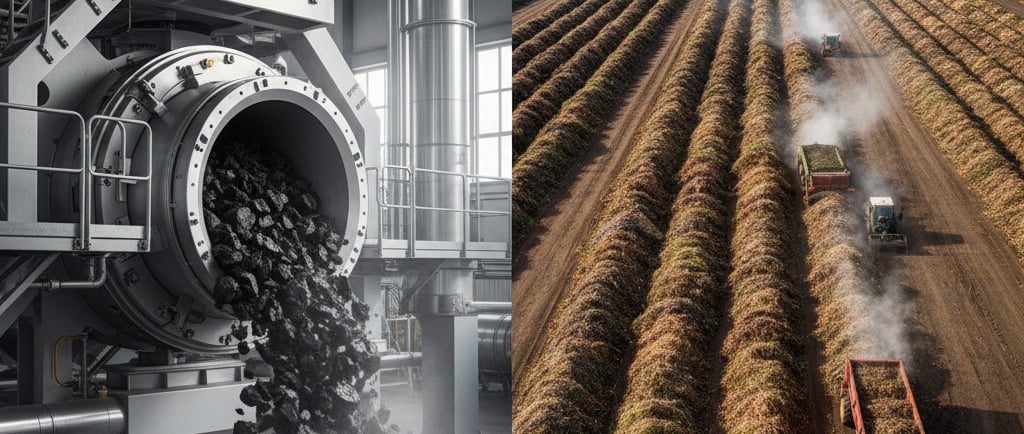
This lecture will address the industrial-scale biological engineering required to bridge this gap. We will move from the microscopic scale of microbial inoculation to the macroscopic scale of bulk soil amendment. Our focus will be on two complementary technologies for creating soil organic matter ex nihilo: the production of biochar through pyrolysis, and the generation of compost through aerobic decomposition. These two processes will allow us to rapidly inject massive quantities of stable carbon and labile nutrients into our nascent technosol, dramatically accelerating its development and creating a substrate capable of supporting higher plants within decades, not millennia.
The Central Role of Soil Organic Matter (SOM)
Before detailing the production methods, we must first formalize the importance of what we are trying to create. Soil Organic Matter (SOM) is the key determinant of soil fertility and health. Its functions are multifaceted and indispensable:
Water Retention: SOM, particularly its humic components, acts like a sponge. It can hold up to 20 times its weight in water, vastly increasing the water-holding capacity of a sandy substrate and reducing water loss to deep percolation.
Nutrient Cycling and Retention: SOM possesses a high cation exchange capacity (CEC), meaning its surfaces have a negative electrical charge that can attract and hold onto positively charged nutrient ions (cations) like potassium (K+), calcium (Ca2+), and magnesium (Mg2+), preventing them from being leached away by irrigation. It is also the primary reservoir of organic nitrogen and phosphorus.
Soil Structure: Organic matter acts as a glue, binding mineral particles (sand, silt, and clay) into stable aggregates. This aggregation creates a porous soil structure that allows for good aeration (essential for root respiration) and water infiltration.
Microbial Habitat: SOM is both the habitat and the primary energy source for the vast majority of the soil food web, from bacteria and fungi to earthworms and insects.
Our microbial beachhead initiates the formation of SOM, but to create a deep, productive soil, we need to add orders of magnitude more organic matter than the microbes can produce in the short term. This is the role of biochar and compost.
Biochar: The Stable Carbon Skeleton
Biochar is a charcoal-like substance produced by heating organic biomass in a low-oxygen or oxygen-free environment, a process known as pyrolysis. It is not simply burnt ash; it is the recalcitrant carbon skeleton of the original biomass.
The Pyrolysis Process:
Feedstock: The process begins with a source of lignocellulosic biomass. For the Saharan project, this would initially be imported (e.g., agricultural waste, forestry residues) and later sourced from dedicated, fast-growing, non-food energy crops (like bamboo or sorghum) grown in the first irrigated zones.
The Reactor: The biomass is fed into a pyrolysis reactor. At temperatures ranging from 350°C to 700°C in the absence of oxygen, the complex organic polymers (cellulose, hemicellulose, lignin) break down.
Outputs: The process yields three primary products:
Biochar: The solid, carbon-rich solid residue.
Bio-oil (Pyrolysis Oil): A liquid mixture of condensable organic compounds.
Syngas: A mixture of non-condensable gases, including hydrogen (H2), carbon monoxide (CO), carbon dioxide (CO2), and methane (CH4).
Energy Self-Sufficiency: A key advantage of pyrolysis is that the syngas and bio-oil byproducts are combustible. They can be captured and used as fuel to power the pyrolysis process itself, making it largely energy self-sufficient after the initial startup.
The Properties and Functions of Biochar:
Extreme Porosity and Surface Area: The pyrolysis process creates a highly porous structure in the biochar, akin to a microscopic honeycomb. A single gram of biochar can have a surface area of several hundred square meters. This vast surface area is a key to its function.
Water Retention: This porous structure acts like a network of microscopic reservoirs, physically trapping water and making it available to plant roots and microbes long after an irrigation event. When added to sand, it dramatically increases its water-holding capacity.
Microbial Refuge: The pores provide a protected habitat for beneficial microbes, shielding them from predation and environmental extremes. This "microbial reef" effect can lead to a significant increase in the abundance and diversity of the soil microbiome.
Nutrient Adsorption: The surfaces of biochar can adsorb nutrients, reducing leaching and creating a slow-release reservoir for plants. Its properties can be tuned by adjusting pyrolysis conditions to enhance its ability to retain specific nutrients.
Carbon Sequestration: The most significant property of biochar is its stability. The aromatic carbon structures created during pyrolysis are highly resistant to microbial decomposition. Biochar can remain in the soil for hundreds to thousands of years, making it an exceptionally effective method for long-term carbon sequestration. By converting atmospheric CO2 (fixed by the biomass feedstock) into this stable form, the Sahara Reforestation Project becomes a powerful carbon sink.
Compost: The Labile Nutrient and Biological Inoculant
If biochar is the stable skeleton of the new soil, compost is its living, breathing flesh. Compost is organic matter that has undergone aerobic (oxygen-rich) decomposition by a community of microorganisms.
The Composting Process:
Feedstock: The feedstock for Saharan composting facilities would be diverse. It would include organic waste from the project's enclosed farms and human settlements, imported agricultural waste, and eventually, the green matter from the developing Saharan ecosystems. A balanced carbon-to-nitrogen (C:N) ratio is crucial for efficient decomposition.
Aerobic Decomposition: The feedstock is arranged in large piles (windrows) or placed in enclosed vessels. This material is kept moist and is regularly aerated (turned or force-aerated) to maintain aerobic conditions.
Microbial Succession: The process is driven by a succession of microbial communities. Initially, mesophilic microbes break down the most readily available compounds. As the pile heats up from their activity (to 55-65°C), thermophilic microbes take over, breaking down more resistant materials like cellulose and killing potential pathogens and weed seeds. Finally, as the pile cools, mesophilic organisms return to complete the maturation process.
Final Product: The result is a dark, crumbly, nutrient-rich material that is a combination of partially decomposed organic matter, stable humus, and a dense, diverse population of beneficial microorganisms.
The Functions of Compost:
Nutrient Supply: Unlike biochar, which is largely nutrient-poor, compost is a rich source of both macro- and micronutrients in a slow-release, organic form. It acts as a natural fertilizer, feeding the soil food web.
Biological Inoculation: Compost is not sterile; it is teeming with life. Adding compost to the nascent Saharan soil is a massive inoculation event, introducing a diverse community of beneficial bacteria, fungi, protozoa, and nematodes that are essential for a functioning soil food web and for disease suppression.
Soil Aggregation: The complex organic compounds and microbial exudates in compost are highly effective at binding sand particles into stable aggregates, creating the porous structure that is vital for root growth, aeration, and water infiltration.
Synergy: The Biochar-Compost Complex
Neither biochar nor compost alone is a perfect solution. Their true power is realized when they are used in concert. A common strategy is to "charge" the biochar by co-composting it with the organic feedstock.
"Charging" Biochar: During the composting process, the highly porous biochar becomes saturated with the nutrient-rich liquids and colonized by the beneficial microbes from the compost.
The Combined Effect: When this biochar-compost complex is applied to the Saharan sand, it delivers a powerful one-two punch:
The compost provides an immediate supply of labile nutrients and a diverse microbial community.
The biochar provides a long-lasting, stable structure that retains water, houses the microbes, and slowly releases the nutrients it adsorbed during the composting process.
This synergistic combination rapidly transforms the physical, chemical, and biological properties of the sand, creating a high-performance growing medium in a fraction of the time it would take for natural processes to occur.
Logistics and Scale of Production
The production of biochar and compost must match the continental scale of the project. This requires the construction of a distributed network of large-scale biorefineries. These facilities would be strategically located along the water grid corridors.
Biochar Production: This would involve arrays of industrial-scale pyrolysis reactors. The syngas byproduct would power the facilities, with excess energy potentially fed back into the grid. The logistics of sourcing and transporting sufficient biomass feedstock would be a major undertaking in the project's early decades.
Compost Production: This would require vast areas for windrow composting or the construction of large, industrial-scale in-vessel composting systems. Managing the water inputs for composting in an arid environment would be critical, relying on recycled water from the grid.
The application of the biochar-compost amendment would be a continuous process, with specialized machinery tilling the material into the top 20-30 cm of irrigated sand in advance of planting the pioneer forests and agricultural crops.
Conclusion: Accelerating Pedogenesis
The microbial beachhead, as discussed in our previous lecture, initiates the process of soil creation on a microscopic scale and over long timescales. The mass production and application of biochar and compost represent a deliberate, large-scale intervention to dramatically accelerate this process. Biochar provides the stable, porous carbon framework—the physical structure and water-retaining sponge. Compost provides the immediate nutrient supply and the diverse biological community—the living engine of the soil.
By combining these two approaches, we are not merely amending sand; we are engineering the rapid assembly of a fertile soil. We are taking a process that would naturally take centuries or millennia and compressing it into decades. This engineered "technosol" is the final preparatory step. The ground is now, finally, ready.
Our next lecture, "The First Green Line: Planting the Great Green Wall," will detail the selection and planting of the first higher plants—the hardy trees and shrubs that will form the initial shelterbelts, the vanguard of the new Saharan forest. Thank you.