Add your promotional text...
Lecture 7: The First Green Line: Planting the Great Green Wall
Series: The Sahara Reforestation Project: From Dune Sea to Green Valley Part I: The Foundation - Analysis and Initial Interventions
3/13/20266 min read
Introduction: From Soil to Seedling
Welcome. Our previous lectures have established a foundational infrastructure for life in the Sahara. We have secured a water supply through desalination and aquifer extraction, engineered a continental grid to deliver it, and initiated the complex process of pedogenesis—transforming sterile sand into a living soil through microbial inoculation and the mass application of biochar and compost. The substrate is now prepared. The stage is set for a pivotal moment in the terraforming process: the introduction of higher plant life on a landscape scale.
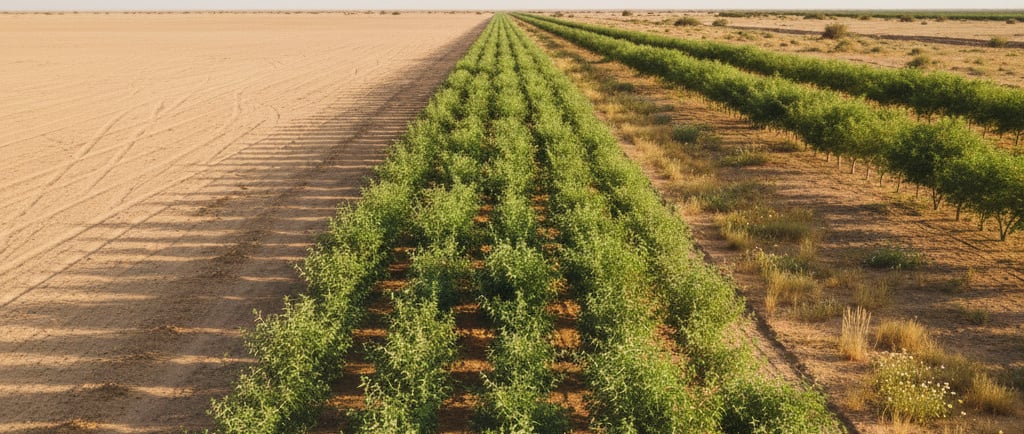
This lecture will detail the strategy and execution of planting the "First Green Line." This is not a haphazard scattering of seeds, but a highly strategic, biologically informed engineering project. We will refer to this initial, large-scale planting as our own "Great Green Wall," an echo of the contemporary pan-African project, but with a more intensive, technologically-driven approach. This massive shelterbelt of pioneer trees and shrubs serves a dual purpose: it is our primary defense against the harsh physical environment of the desert, and it is the first active step in creating a new, self-reinforcing microclimate. Our focus will be on the biological characteristics of the selected pioneer species—organisms chosen not for their economic value, but for their sheer tenacity and their ability to thrive where little else can.
The Strategic Imperative of the Shelterbelt
Before delving into species selection, we must first articulate the critical functions of this initial green line. It is a multi-functional ecological engineering tool designed to mitigate the Sahara's most hostile environmental factors.
Eolian (Wind) Erosion Control: The Sahara is dominated by powerful, persistent winds, such as the Harmattan. These winds can carry vast quantities of sand and dust, creating a physically abrasive environment that can sandblast young plants and bury entire agricultural zones under shifting dunes. A dense, multi-layered belt of trees and shrubs acts as a porous barrier, dramatically reducing wind velocity at the surface. This reduction in wind speed causes the wind to drop its sediment load, stabilizing the soil on the leeward side and protecting the areas designated for more sensitive agriculture and afforestation.
Microclimate Modification: The presence of a significant biomass has a profound impact on the local energy and water balance.
Temperature Regulation: The canopy of the shelterbelt provides shade, reducing peak daytime soil temperatures and preventing excessive heat stress on understory plants and the soil microbiome. At night, it can trap a small amount of outgoing longwave radiation, slightly buffering against extreme cold.
Humidity Enhancement: Through transpiration, the plants release significant amounts of water vapor into the local atmosphere. In the calm air on the leeward side of the windbreak, this water vapor can accumulate, raising the relative humidity and creating a more favorable microclimate for other species. This also reduces the evaporative demand on the soil and the plants themselves.
Ecological Nucleation: The shelterbelt acts as a "nucleus of ecosystem development." It provides a habitat and food source for the first introduced insects and animals. Its continuous shedding of leaf litter provides a steady stream of organic matter to the soil, nurturing the microbial community and accelerating soil development. It becomes a corridor of life from which other species can later radiate.
The design of the wall would be a massive undertaking, likely consisting of multiple parallel belts, each several kilometers wide, planted perpendicular to the prevailing wind direction, stretching for thousands of kilometers across the continent.
Species Selection: The Biological Attributes of a Pioneer
The success of the First Green Line hinges entirely on the selection of the right biological toolkit. The chosen species must be "pioneer species" in the truest sense, capable of colonizing and thriving in a harsh, nascent environment. The selection criteria are rigorous, focusing on a suite of xerophytic (drought-adapted) and halophytic (salt-adapted) traits.
Drought Tolerance Mechanisms:
Extensive Root Systems: The primary trait is the ability to develop deep taproots to access moisture from lower soil profiles, as well as extensive lateral roots to capture surface moisture from irrigation.
Stomatal Control: Efficient regulation of stomata (leaf pores) to minimize water loss during the hottest parts of the day.
Osmotic Adjustment: The ability to accumulate solutes in their cells to maintain turgor pressure even as the soil water potential drops.
Leaf Morphology: Adaptations such as small leaf size (microphylls), a thick waxy cuticle, sunken stomata, and pubescent (hairy) surfaces all reduce water loss. Some species may even be deciduous, dropping their leaves during the most extreme dry periods.
Salt Tolerance (Halophytism): Given the use of treated aquifer water and the inherent risk of soil salinization from high evaporation, tolerance to salt is critical. Mechanisms include ion exclusion at the root level, sequestration of salts in vacuoles, and the excretion of salt through specialized glands on the leaves.
Nitrogen Fixation: A significant advantage is the ability to form symbiotic relationships with nitrogen-fixing bacteria (like Rhizobium). Leguminous trees, such as many Acacia species, can fix their own nitrogen, enriching the soil for subsequent species and reducing the need for external fertilizers.
Rapid Growth and Biomass Production: Pioneers need to grow quickly to establish a canopy and begin their work of environmental modification.
Genetic Diversity: The deployed populations must have high genetic diversity to provide a broad adaptive capacity to local variations in soil, water, and climate across the vast expanse of the Sahara.
Candidate Species: A Profile of Tenacity
Based on these criteria, the initial planting palette would be drawn from native and analogous arid-land ecosystems.
Acacia species (e.g., A. tortilis, A. ehrenbergiana): These are the archetypal trees of arid Africa. They are legumes, capable of nitrogen fixation. Their deep taproots are legendary, and their thorny branches and small leaves are classic xerophytic adaptations. They provide light, dappled shade that allows grasses to grow underneath, forming a classic savanna structure.
Balanites aegyptiaca (Desert Date): An exceptionally hardy, slow-growing but long-lived tree. It is extremely drought- and salt-tolerant and produces an oil-rich fruit, providing a potential early-stage resource. Its robustness makes it an ideal candidate for the most exposed parts of the shelterbelt.
Leptadenia pyrotechnica (Fire Bush): This is a nearly leafless shrub, a classic example of a plant that reduces water loss by minimizing its surface area. It has an extensive root system and is one of the most drought-resistant plants in the Sahara, capable of stabilizing mobile sand dunes. It would form the dense, lower layer of the windbreak.
Prosopis juliflora (Mesquite): A controversial but highly effective pioneer. Mesquite is an aggressive, fast-growing nitrogen-fixing tree with an incredibly deep taproot. While its invasive potential must be carefully managed (perhaps by deploying sterile cultivars), its ability to thrive in the harshest conditions, lower the water table, and produce large amounts of biomass is undeniable.
Atriplex species (Saltbush): These are premier halophytes. Various species of saltbush can tolerate extremely high levels of soil salinity. They would be planted in areas with high salinization risk, acting as biological salt pumps and providing a source of forage for hardy livestock.
Planting and Establishment: A High-Tech Approach
The planting of billions of seedlings across thousands of kilometers cannot be done with shovels alone. It requires a semi-automated, technologically-driven approach.
Nursery Production: Massive, climate-controlled nurseries would be established along the water grid. Here, seedlings would be mass-produced. A critical step would be the pre-inoculation of each seedling's root ball with its specific microbial partners—the correct strains of nitrogen-fixing bacteria and mycorrhizal fungi identified in previous lectures. This ensures the symbiosis is established from day one.
Automated Planting: The deployment would likely involve a fleet of semi-autonomous planting vehicles. These machines would drill an auger into the amended soil, deposit the seedling, inject a dose of water and hydrogel to buffer against transplant shock, and move on to the next site, guided by GPS.
Precision Irrigation: Each seedling would be supplied by a dedicated drip emitter from the water grid. This precision irrigation system, controlled by the central AI, would deliver a precise amount of water directly to the root zone, minimizing waste. Soil moisture sensors at regular intervals would provide real-time feedback to optimize the irrigation schedule.
Phased Establishment: The shelterbelt would be planted in phases. An initial, very dense planting of the hardiest shrubs (Leptadenia, Atriplex) would create the primary windbreak. Once this first line is established and begins to calm the local environment, the faster-growing trees (Acacia, Prosopis) would be planted in its lee, followed by the slower-growing, longer-lived species (Balanites).
Conclusion: The First Green Shoots of a New World
The planting of the First Green Line is a profound turning point in the Sahara Reforestation Project. It represents the transition from a preparatory phase of engineering and soil creation to an active phase of ecological development. This massive shelterbelt is far more than a simple windbreak; it is a living machine designed to actively combat the desert's harshest characteristics. It will stabilize the soil, reduce the desiccating power of the wind, and begin to create a cooler, more humid microclimate in its protective shadow.
This green line is the nurturing environment, the protected zone where the next, more complex stages of afforestation and agriculture can begin. It is the first large-scale, self-reinforcing biological system in our project, where the outputs of the system (humidity, shade, organic matter) become beneficial inputs that support its own growth and the establishment of other species.
With the First Green Line taking root, we have created a beachhead not just of microbes, but of complex, multicellular life. The stage is now set to explore the next critical challenge: managing the inevitable accumulation of salt in an irrigated desert. Our next lecture, "Salinity Management: The Challenge of Desert Soils," will delve into the biological and engineering strategies required to ensure the long-term viability of our new green Sahara. Thank you.