Add your promotional text...
Lecture 8: Salinity Management: The Challenge of Desert Soils
Series: The Sahara Reforestation Project: From Dune Sea to Green Valley Part I: The Foundation - Analysis and Initial Interventions
3/16/20266 min read
Introduction: The Inevitable Consequence of Irrigation
Welcome. In our preceding lectures, we have successfully established the foundational elements for greening the Sahara. We have secured water, built a transport grid, created a nascent soil, and planted the first pioneering shelterbelts. We have, in effect, started the engine of a new ecosystem. However, in doing so, we have also initiated an insidious, long-term challenge that has plagued irrigated agriculture in arid lands for millennia: secondary salinization. This is the gradual accumulation of salts in the root zone of the soil, a direct and inevitable consequence of applying irrigation water in a high-evaporation environment.
History is replete with examples of civilizations, from ancient Mesopotamia to more recent agricultural projects, that have collapsed or failed due to their inability to manage soil salinity. For the Sahara Reforestation Project, a multi-millennial endeavor, managing salt is not an afterthought; it is a central, perpetual challenge that must be engineered into the very fabric of the system from its inception.
This lecture will provide a detailed analysis of the biogeochemical processes of salinization. We will then outline a dual-pronged management strategy. The first is an engineering approach, focusing on high-efficiency irrigation and the critical design of subsurface drainage systems to leach and remove salts. The second is a biological approach, leveraging the remarkable capabilities of halophytic plants—organisms that thrive in saline conditions—to actively extract salts from the soil in a process known as phytoremediation.
The Process of Secondary Salinization
To manage salinization, we must first understand its mechanism. All irrigation water, whether from desalination plants or treated aquifer water, contains a certain concentration of dissolved salts (measured as Total Dissolved Solids, TDS, or by Electrical Conductivity, EC). While this concentration may be low enough for plants to tolerate initially, the problem arises from the water balance in an arid climate.
Water Application: We apply irrigation water to the soil.
Plant Uptake and Transpiration: Plants absorb a portion of this water through their roots and transpire it through their leaves as pure H2O, leaving the salts behind in the soil solution.
Surface Evaporation: The intense solar radiation of the Sahara causes a significant amount of water to evaporate directly from the soil surface, also leaving its entire salt load behind.
Salt Accumulation: Because precipitation is negligible, there is no natural, large-scale flushing mechanism to wash these accumulated salts down and out of the soil profile. Over time, with each irrigation cycle, the concentration of salts in the remaining soil water steadily increases.
Capillary Action: As the surface dries, capillary action wicks the now-saline water from deeper in the soil profile up to the surface, where it evaporates, depositing a visible crust of salt.
The consequences for non-adapted plants (glycophytes) are severe. High salt concentrations in the soil create a low osmotic potential, making it physically difficult for roots to draw water out of the soil—a condition known as "physiological drought." Furthermore, high concentrations of specific ions, particularly sodium (Na+) and chloride (Cl-), can be directly toxic to plant cells and can degrade soil structure, leading to a sodic soil that is impermeable and difficult to cultivate.
The Engineering Solution: Leaching and Drainage
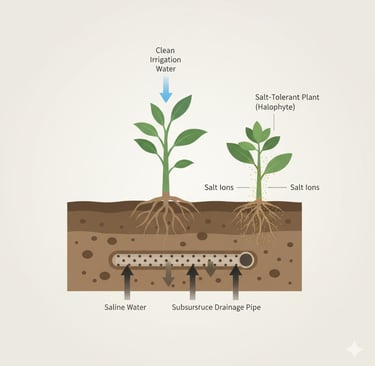
The fundamental engineering principle for managing salinity is the "leaching requirement." This is the calculated amount of excess irrigation water that must be applied to the soil to dissolve accumulated salts and flush them down below the root zone. Without a system to remove this saline leachate, the problem is merely displaced downwards, and the water table will eventually rise, waterlogging the root zone with toxic brine.
Therefore, a successful irrigation system in the Sahara must be inextricably linked to a subsurface drainage system.
High-Efficiency Irrigation: The first line of defense is to minimize the amount of water applied in the first place, thus reducing the total salt load introduced. The entire Saharan agricultural system will be based on drip irrigation, which delivers water directly to the plant's root zone with efficiencies exceeding 90%. This contrasts sharply with flood or sprinkler irrigation, where evaporative losses can be 40-60%.
Subsurface Drainage Design: This is the critical engineering component. A network of perforated pipes (tile drains) would be installed deep in the soil, typically 1.5 to 2.5 meters below the surface, underlying the agricultural and forestry zones. The design of this network—its depth, spacing, and grade—is a complex hydro-engineering task determined by soil type, irrigation rates, and the specific leaching requirement of the crops being grown.
The Leaching Process: Periodically, a calculated "flushing" or "leaching" irrigation would be applied. This excess water percolates through the root zone, dissolves the accumulated salts, and carries them down into the subsurface drainage pipes.
Brine Management and Disposal: The drainage system collects this saline effluent. This brine is too salty to be reused for most crops directly and cannot be discharged into the newly forming freshwater rivers. It must be managed. The strategy would involve:
Collection in Evaporation Ponds: The effluent would be channeled to large, lined evaporation ponds located in designated non-agricultural basins. Here, the water evaporates, leaving behind concentrated salt deposits that could potentially be harvested for industrial minerals.
Halophyte Aquaculture: A more productive approach involves channeling the brine into managed wetlands or ponds to cultivate extremely salt-tolerant algae (like Dunaliella salina, a source of beta-carotene) or to irrigate dedicated halophyte crops.
This engineering approach is effective but requires significant capital investment, ongoing maintenance of the drainage network, and careful management of the resulting brine.
The Biological Solution: Phytoremediation with Halophytes
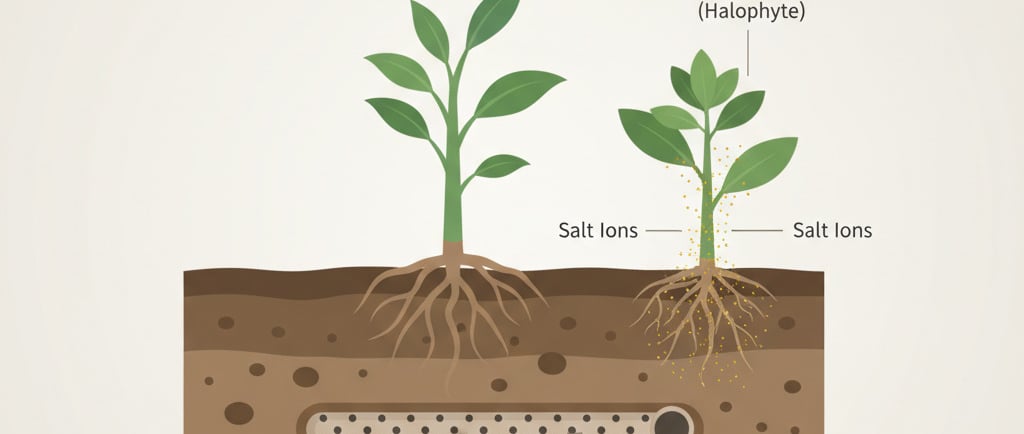
Nature has already evolved organisms that are masters of salinity management. Halophytes are plants that are adapted to grow and thrive in soils with high salt concentrations. We can deploy these plants as biological tools to actively manage soil salinity in a process called phytoremediation.
Mechanisms of Salt Tolerance in Halophytes: Halophytes are not simply "tough"; they possess sophisticated physiological and biochemical mechanisms:
Ion Sequestration: Many halophytes take up salt from the soil but sequester the toxic ions (Na+, Cl-) inside the vacuoles of their cells, protecting the sensitive metabolic machinery in the cytoplasm.
Salt Glands/Bladders: Some species have specialized structures on their leaves, like salt glands or salt bladders, which actively excrete excess salt onto the leaf surface, where it can be washed away by rain (or, in our case, overhead irrigation) or removed when the leaves are shed.
Osmotic Adjustment: Like xerophytes, they accumulate compatible organic solutes in their cytoplasm to balance the low osmotic potential of the saline water in their vacuoles and the soil, allowing them to continue absorbing water.
Strategic Deployment of Halophytes: Halophytes would be integrated into the Saharan agricultural landscape in several key ways:
Rotational Crops: In fields where salinity is gradually increasing, a salt-tolerant crop like quinoa or barley could be followed by a full season of a dedicated halophyte crop (e.g., Suaeda spp., Salicornia spp.). This halophyte crop would "mine" the excess salt from the topsoil, which is then removed from the field at harvest, effectively "resetting" the salinity level.
Buffer Zones and Intercropping: Belts of perennial halophytic shrubs (e.g., Atriplex spp. - Saltbush) could be planted around and between fields of conventional crops. Their deep roots can help control the saline water table, and they can be harvested for animal fodder, creating an economic byproduct.
Brine-Fed Agriculture: The saline effluent collected by the subsurface drainage systems would be used to irrigate dedicated "saline farms." Here, cash crops that are themselves extreme halophytes could be cultivated. Examples include:
Salicornia (Sea Asparagus): A gourmet vegetable that thrives on seawater-level salinity.
Suaeda species: Can be used for forage or as a source of oilseed.
Mangroves: In coastal areas, the brine could be used to support the establishment of mangrove forests, which are both highly valuable ecosystems and effective salt managers.
The "Bio-Drainage" Concept: The strategic planting of deep-rooted, high-transpiration halophytes (and other phreatophytes like Eucalyptus in less saline areas) can act as a form of "bio-drainage." By drawing significant amounts of water directly from the upper layers of the water table, these plants can help prevent it from rising too close to the surface, providing a biological complement to the engineered tile drain systems.
An Integrated Salinity Management System
The most resilient and sustainable strategy for the Sahara is not a choice between engineering and biology, but their complete integration. The system would operate as a multi-layered defense:
Layer 1 (Prevention): Ultra-efficient drip irrigation minimizes the initial salt load.
Layer 2 (Control): Subsurface tile drainage systems actively leach and remove salts from the root zone of high-value crops.
Layer 3 (Bioremediation): Rotational and intercropped halophytes actively extract salts from agricultural soils, recycling them into useful biomass.
Layer 4 (Recycling): The saline effluent from the drainage systems is repurposed as a resource to irrigate dedicated saline farms and aquaculture ponds.
This integrated approach transforms the problem of salt from a simple waste product to be disposed of into a resource to be managed and utilized within a circular economy.
Conclusion: Closing the Salt Loop
Salinization is an existential threat to any arid-land agricultural project. A reactive approach is doomed to failure. The strategy for the Sahara Reforestation Project must be proactive, integrating salinity management into the design of every irrigated hectare from day one.
The combination of high-tech engineering—precision irrigation and subsurface drainage—and sophisticated biological tools—the targeted deployment of halophytic plants—provides a robust framework for managing this threat in perpetuity. By viewing salt not as a poison but as a displaceable and utilizable resource, we can design a system that leaches, captures, and repurposes it, creating a closed salt loop. This ensures the long-term fertility of the newly created soils and the sustainability of the entire terraforming endeavor.
Having addressed the critical issue of soil salinity, we are now prepared to explore the symbiotic relationships that will supercharge our pioneer plants. Our next lecture, "Mycorrhizal Inoculation: The Symbiotic Advantage," will detail the mass deployment of beneficial fungi to create a living, intelligent network beneath the soil, dramatically enhancing the resilience and efficiency of the new Saharan flora. Thank you.