Add your promotional text...
Nature's Super-Goo: How Bacterial Slime Can Revolutionize Our Soil
Source & Further Information: The findings and concepts discussed in this article are largely based on the research presented in the following scientific paper: Saha I, Datta S, Biswas D. Exploring the Role of Bacterial Extracellular Polymeric Substances for Sustainable Development in Agriculture. Curr Microbiol. 2020 Nov;77(11):3224-3239. doi: 10.1007/s00284-020-02169-y. Epub 2020 Sep 2. PMID: 32876713.. We encourage readers interested in the detailed methodology and complete results to consult the original publication.
10/22/20253 min read
For decades, modern agriculture has relied on a simple formula: add chemical NPK (nitrogen-phosphorous-potassium) fertilizers to get bigger yields. While effective in the short term, this approach comes at a cost, slowly degrading the health of our soil and polluting nearby rivers and lakes. But what if the secret to healthier soil and sustainable farming isn't in a chemical factory, but already exists in the ground beneath our feet?
Meet the unsung heroes of the soil: billions of bacteria that produce a remarkable substance known as Extracellular Polymeric Substances (EPS). Think of it as a beneficial, sticky "super-goo" that could change the way we grow food.
What is This Bacterial Super-Goo?
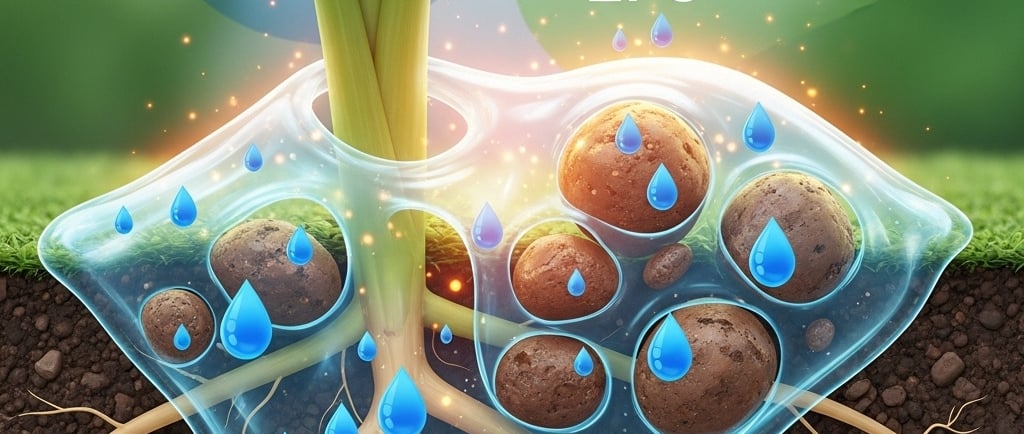
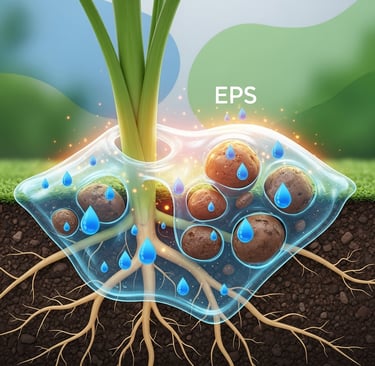
When faced with tough conditions like drought or lack of nutrients, soil bacteria don't just give up. They band together, creating protective communities called biofilms. The "glue" holding these communities together and sticking them to surfaces (like plant roots or soil particles) is EPS.
This goo is a complex matrix made mostly of long-chain sugars (polysaccharides), but also contains proteins, lipids, and even DNA. It forms a protective, life-sustaining bubble around the bacteria, shielding them from stress, helping them communicate, and trapping nutrients. Because EPS is naturally produced, it's biodegradable, non-toxic, and a renewable resource – a perfect eco-friendly alternative to synthetic chemicals.
The Superpowers of EPS for Agriculture
While EPS is already used in industries from food and cosmetics to medicine, its true potential in farming is only now being fully explored. This natural slime offers a powerful toolkit for restoring soil health and boosting plant growth.
1. Natural Soil Conditioner & Glue: The adhesive nature of EPS is a game-changer for soil structure. It binds tiny soil particles together, forming stable clumps called aggregates. This improves soil texture, aeration, and depth, making it easier for roots to grow. Crucially, this "gluing" action makes soil far more resistant to erosion from wind and water.
2. A Microscopic Sponge for Moisture: EPS is naturally hygroscopic, meaning it attracts and holds onto water. By creating a hydrated microenvironment around plant roots, it acts like a tiny sponge, retaining moisture even when the surrounding soil is dry. This is a massive benefit in combating drought stress and ensuring plants have access to water when they need it most.
3. A Shield Against Salt Stress: In areas with high soil salinity, excess salt can prevent plants from taking up water and poison their cells. EPS can bind to harmful salt ions (like sodium), effectively trapping them and reducing the amount that reaches the plant roots, acting as a protective shield.
4. A Partner in Fertilization (Nitrogen Fixation): Some of the most important soil bacteria are those that "fix" nitrogen, converting it from a gas in the atmosphere into a form plants can use. This process relies on a very oxygen-sensitive enzyme. EPS creates a protective barrier around these bacteria, shielding the enzyme from oxygen and allowing the natural fertilization process to happen more efficiently.
5. A Bodyguard Against Disease: EPS can also act as a plant's bodyguard. It can have antimicrobial properties that fight off disease-causing pathogens or trigger the plant's own immune system, a phenomenon known as "induced systemic resistance," preparing it to fend off future attacks.
The Future is Sustainable (and a Little Slimy)
The beauty of using EPS in agriculture is its efficiency. For applications like improving soil structure, the raw substance can be used without the expensive purification steps needed for medical or food-grade products. Researchers are even exploring ways to produce EPS by feeding bacteria on agricultural and industrial waste, turning a disposal problem into a valuable resource.
By harnessing the power of this natural super-goo, we can move towards a more sustainable model of agriculture – one that enriches our soil, protects our waterways, and helps us grow the food we need without relying so heavily on synthetic chemicals. The solution, it seems, has been right under our noses all along.