Add your promotional text...
Our Global Food System is Draining Our Soils. Here's How.
Source & Further Information: The findings and concepts discussed in this article are largely based on the research presented in the following scientific paper: Silver WL, Perez T, Mayer A, Jones AR. The role of soil in the contribution of food and feed. Philos Trans R Soc Lond B Biol Sci. 2021;376(1834):20200181. doi:10.1098/rstb.2020.0181. We encourage readers interested in the detailed methodology and complete results to consult the original publication.
9/12/20253 min read

Every meal we eat begins with the soil beneath our feet. It's the anchor for plants, the source of essential nutrients, and the foundation of our entire food system. For thousands of years, we've managed soils to grow food and feed animals. But in our modern, globalized world, a dangerous trend is emerging: we are effectively "mining" our soils, shipping their vital nutrients across continents, and using them in surprisingly inefficient ways, with much of this natural wealth ending up wasted.
The Great Soil Nutrient Heist
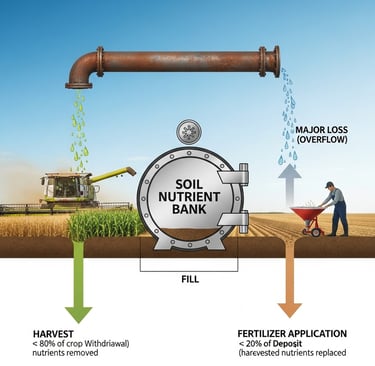
Think of farming as a bank account. Plants draw nutrients like Nitrogen (N) and Phosphorus (P) from the soil "account" and store them in their tissues. When we harvest these crops, we're making a withdrawal and shipping those nutrients away. This is true whether we eat the plants directly or feed them to livestock.
To keep the account from going bankrupt, we must make deposits in the form of fertilizers. But these deposits rarely match the withdrawals, leading to a slow but steady depletion of soil fertility and widespread land degradation. This problem is supercharged by a global food system that has become incredibly interconnected.
International trade in agricultural products has doubled in recent decades, creating a massive, intercontinental flow of soil nutrients. Millions of tons of N and P, originally from soils in one country, are embedded in crops and shipped thousands of miles away. While some of these nutrients nourish people, a huge portion is lost or wasted, often ending up concentrated in urban waste streams where they can cause pollution, rather than being returned to the depleted soils that need them.
The Inefficiency of Animal Feed
A major finding of recent research highlights a huge inefficiency in how we use our most fertile lands and soil resources. The study, analyzing key staple crops like maize, soy, rice, and wheat, revealed a startling pattern:
Feed Over Food: The world's most productive soils, rich in organic matter and nitrogen, are often not used to grow food directly for people. Instead, they are overwhelmingly dedicated to growing animal feed, particularly maize and soy.
Massive Nutrient Diversion: In North America and Asia, for example, over 70% of maize production goes to animal feed. For soy grown in the Americas and Europe, that figure climbs to over 90%.
The "Leaky Bucket" Effect: This system is like using a leaky bucket to carry water. When we feed crops to animals, a huge portion of the original calories and nutrients are lost in the conversion process. Less than 10% of the protein from feed crops is ultimately consumed by humans as meat. For example, shifting 16 major crops from feed to 100% human food could increase available food calories by a staggering 49% globally.
This isn't to say livestock has no role—animals raised on grasslands or fed waste products can be a net gain for the food system. But using our best croplands to grow feed for livestock is a major drain on global soil resources.
A World on the Move: Tracking Nutrient Flows
The global trade in just soy and maize represents a massive displacement of soil nutrients. North and South America are the primary exporters, shipping millions of tons of N and P embedded in these crops to importers like Asia and Europe, largely to fuel their livestock industries.
Consider this: the nitrogen exported in soy from North and South America is equivalent to a massive chunk (23% and 58%, respectively) of the total nitrogen fertilizer used for all crops in those regions. This illustrates the sheer scale of nutrient loss from these soils, a loss that must be offset by energy-intensive fertilizers, which come with their own environmental costs.
The Role of Small Farms & The Path Forward
It's not all about large-scale industrial farming. Small farms (under 2 hectares) are responsible for about a third of the global food supply, often producing more diverse and micronutrient-rich foods. However, they face their own challenges, including "yield gaps" where their production potential isn't met due to economic constraints and lack of access to resources.
So, how can we better protect our vital soil resources while feeding a growing population? The research points to a multi-pronged approach:
Shift to Nutrient-Efficient Diets: Reducing reliance on feed-intensive meat and dairy products in wealthier nations would free up immense amounts of land and soil nutrients for direct human consumption, significantly increasing the efficiency of our food system.
Strategic Intensification: We need to find ways to sustainably increase crop yields on existing farmland, particularly on small farms, to reduce the pressure to clear more land. This includes using technology and better management practices that are tailored to local soil conditions.
Restore and Maintain Soil Fertility: We must prioritize practices that rebuild soil health, such as adding organic matter, using cover crops, and implementing smarter fertilizer and water management to stop the "mining" effect of agriculture.
Recycle Nutrients: Finding ways to safely recycle nutrients from urban and agricultural waste back onto farmland is critical to closing the loop and reducing pollution.
Our soils are a finite and precious resource. Recognizing how our global food choices directly impact soil health is the first step toward building a more sustainable and resilient food system for the future.