Add your promotional text...
Resilient Harvests: How Genomics is Fortifying Wheat Against a Hostile Climate
Source & Further Information: The findings and concepts discussed in this article are largely based on the research presented in the following scientific paper: Mao H, Jiang C, Tang C, Nie X, Du L, Liu Y, Cheng P, Wu Y, Liu H, Kang Z, Wang X. Wheat adaptation to environmental stresses under climate change: Molecular basis and genetic improvement. Mol Plant. 2023 Oct 2;16(10):1564-1589. doi: 10.1016/j.molp.2023.09.001. Epub 2023 Sep 9. PMID: 37671604. We encourage readers interested in the detailed methodology and complete results to consult the original publication.
1/28/20264 min read

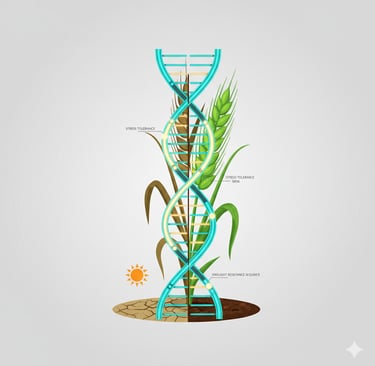
From our morning toast to the pasta on our dinner plate, wheat is a cornerstone of the global diet, providing a huge portion of our daily calories and protein. But this essential crop is in trouble. Climate change is turning up the heat, unleashing more frequent and intense droughts, making soils saltier, and creating perfect conditions for devastating diseases to spread. As the world's population grows, we need to produce more wheat, not less. So, how can we protect our daily bread? The answer may lie hidden within wheat's own complex DNA.
The Challenge: A Perfect Storm for Wheat
Wheat is a resilient crop, adapted over millennia to grow in diverse climates, including semi-arid regions. However, its long growing season makes it vulnerable to a gauntlet of environmental stresses, all of which are being amplified by climate change:
Drought & Heat: These are the twin titans of yield loss. Over 90% of wheat-growing regions now face combined drought and heat stress, events that have become significantly more frequent since the 1980s.
Salty Soils: Poor irrigation practices and rising sea levels are leading to increased soil salinity. Projections suggest that by 2050, half of the world's arable land could be too salty for many crops to thrive.
Rampant Diseases: Warmer temperatures allow fungal pathogens like rusts and powdery mildew to proliferate and move into new territories. Newer threats, like Fusarium head blight (FHB), are also spreading rapidly, reducing yield and contaminating grain with harmful toxins.
To feed a projected 9.7 billion people by 2050, we need a "smarter" wheat—a crop that can maintain high yields even when the weather turns against it. The key to building this super-wheat is to dive deep into its genetics.
Unlocking the Code: The "Golden Age" of Wheat Genomics
For decades, the sheer complexity of the wheat genome—three distinct subgenomes combined, making it massive and complicated—was a major barrier for scientists. But thanks to huge leaps in DNA sequencing technology, we are now in what many consider a "golden age" of wheat genomics. Scientists have successfully mapped high-quality reference genomes for modern wheat and its wild ancestors.
This genetic road map is a game-changer. It allows researchers to:
Find the Genes: Pinpoint specific genes or genetic regions (called QTLs) responsible for desirable traits like drought tolerance, salt exclusion, or disease resistance.
Understand the Trade-offs: See how breeding for high yield (a key goal of the Green Revolution) may have inadvertently weakened some of wheat's natural stress resistance.
Learn from the Past: Study how ancient wheat varieties adapted to different environments, potentially rediscovering valuable genes that were lost in modern lines.
Using powerful techniques like Genome-Wide Association Studies (GWAS), scientists can now scan the DNA of thousands of different wheat varieties and link specific genetic markers to how well they perform under stress. This has led to the identification of hundreds of QTLs related to drought, heat, and salinity tolerance.
Building a Resilient Wheat: The Genetic Toolkit in Action
With this knowledge, scientists are no longer just hoping for the best in breeding. They can now target specific mechanisms. Here's a glimpse of the strategies being developed:
Drought Defense: Genes that promote deeper root systems (like TaDRO1), manage water loss by controlling leaf pores (stomata), and boost antioxidant capacity are being identified and studied. For example, a natural version of a gene called TaNAC071-A has been found to enhance both drought resistance and yield.
Fighting Salinity: A key strategy for salt tolerance is to prevent toxic sodium ions (Na+) from accumulating in the plant's leaves. Scientists have identified powerful "sodium transporter" genes (like HKT genes) that act as gatekeepers, excluding salt from sensitive parts of the plant. Other genes (like those in the SOS pathway) help pump salt out or safely store it in cellular compartments where it can't do harm.
Surviving the Heat: High temperatures can damage essential proteins. Scientists are focusing on "Heat Shock Proteins" (HSPs) and the genes that regulate them. These act like cellular chaperones, protecting and repairing other proteins during heat stress. Researchers are also looking at genes that control flowering time, as heat during this critical reproductive stage can severely impact fertility and grain production.
Disease Resistance: This is a constant arms race. Scientists have cloned dozens of resistance genes (Yr, Lr, Sr, Pm genes) that help wheat fight off specific strains of rusts and powdery mildew. A major breakthrough is the discovery of genes like Fhb7 (from a wild relative of wheat), which can detoxify the harmful mycotoxins produced by Fusarium head blight. The strategy now is to "stack" multiple resistance genes together into a single elite wheat variety, creating a multi-layered defense that is harder for pathogens to overcome.
The Future: From Gene Discovery to Smart Breeding
The path forward isn't just about finding individual genes. The future of wheat breeding involves a multi-faceted, "rational design" approach:
Understanding Networks: Recognizing that stress tolerance isn't controlled by a single gene but by complex networks of interacting genes.
Balancing Trade-offs: Engineering plants that can activate strong defense mechanisms without suffering a major "yield penalty." Sometimes, being too defensive can slow down growth.
Harnessing Modern Tools: Using advanced technologies like CRISPR-Cas9 gene editing to make precise, targeted improvements to stress-response genes, accelerating the breeding process.
Leveraging Microbial Allies: Recognizing that the soil microbiome (beneficial bacteria and fungi) plays a huge role in plant health. Breeding efforts may one day select for wheat varieties that partner more effectively with these helpful microbes.
Conclusion:
The challenges facing our global food supply are immense, but so are the scientific opportunities. By combining our growing knowledge of the wheat genome with powerful new breeding technologies, we are better equipped than ever to develop "smart wheat" varieties that are resilient, adaptable, and high-yielding. The journey from the lab to the farmer's field is complex, but it is essential for ensuring our daily bread remains a staple for generations to come.