Add your promotional text...
Salt Scourge: How Nature's Partnerships Can Heal Our Salty Soils
Source & Further Information: The findings and concepts discussed in this article are largely based on the research presented in the following scientific paper: Tang H, Du L, Xia C, Luo J. Bridging gaps and seeding futures: A synthesis of soil salinization and the role of plant-soil interactions under climate change. iScience. 2024 Aug 23;27(9):110804. doi: 10.1016/j.isci.2024.110804. PMID: 39286506; PMCID: PMC11404172. We encourage readers interested in the detailed methodology and complete results to consult the original publication.
12/31/20254 min read
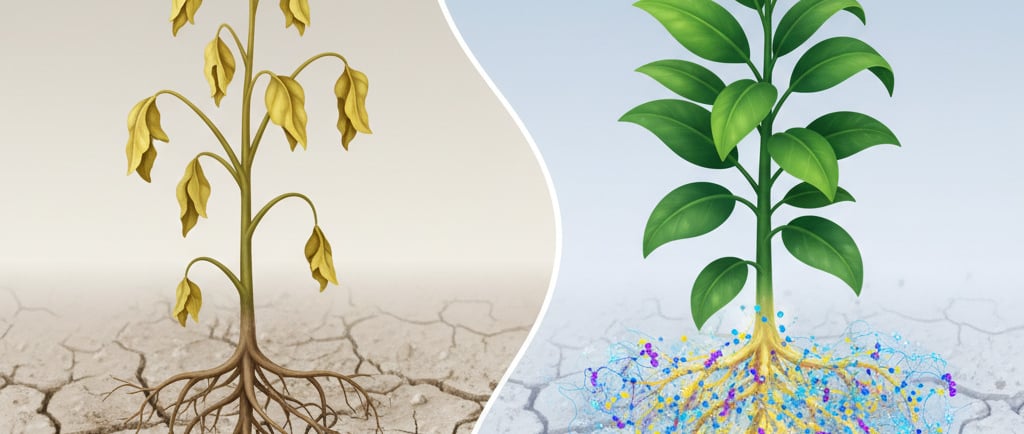
The Growing Threat of Salty Soil
Imagine a field where the soil is slowly turning toxic, not from a chemical spill, but from an invisible, creeping threat: salt. This isn't just happening on coastal farms; it's a global problem called soil salinization, affecting over 800 million hectares of land worldwide. This salty soil stunts plant growth, slashes crop yields, and threatens global food security.
Salinization happens when soluble salts build up in the soil, often due to natural causes like arid climates or human activities like irrigating with salty water. As climate change brings rising temperatures and unpredictable rainfall, this problem is getting worse. More evaporation concentrates salts, while changing rain patterns fail to wash them away. The result is a vicious cycle of land degradation that puts immense pressure on our farms and natural ecosystems.
But what if the solution to this growing crisis is already in the soil itself? Scientists are increasingly looking to the powerful, dynamic relationship between plants and soil—including its vast community of microbes—as a key strategy for a sustainable future.
The Power of Partnership: Plants and Soil Teaming Up
The "plant-soil interaction" isn't just about roots sitting in dirt. It's a complex conversation. Plants release compounds from their roots that influence the microbes around them, while those microbes, in turn, help plants access nutrients and cope with stress. By understanding and harnessing these natural partnerships, we can help plants not just survive, but actively heal salty soils.
Plants have evolved incredible strategies to deal with salt:
Salt Exclusion: Some plants are masters of defense, physically blocking or pumping salt ions out of their roots to prevent them from reaching sensitive leaves.
Root Adaptations: Plants can change how and where their roots grow, diving deeper to find less salty water or developing more extensive networks.
Microbial Alliances: Most excitingly, plants form symbiotic relationships with beneficial soil microbes (like bacteria and fungi) that act as microscopic allies, boosting nutrient uptake, improving water absorption, and even producing compounds that help the plant tolerate stress.
A recent surge in scientific research, which we'll explore here, confirms that these interactions are a crucial pathway to building more resilient ecosystems in the face of climate change.
What the Science Says: A Look at the Research Landscape
A deep dive into the last decade of research reveals a rapidly growing interest in this field. While the general link between plants and salty soil has been known for a while, studies specifically connecting it to climate change and microbial interactions have exploded since 2013.
The analysis shows research hotspots in countries hit hard by salinization, like China, India, and the United States, where the impacts on agriculture drive innovation. But the research also highlighted a critical gap: while we've studied how plants physiologically respond to salt, we've paid less attention to the crucial role of the soil microbial community. These tiny organisms are the unsung heroes of soil health, and we're only just beginning to unlock their potential.
One of the most promising trends is the study of "Inoculation"—the process of intentionally adding beneficial microbes to the soil. Think of it as a probiotic for plants. Studies have shown that introducing specific bacteria (like Pseudomonas or Bacillus) or fungi (like mycorrhizae) can dramatically improve how crops like rice, wheat, and tomatoes handle salt stress. These microbes can help plants find more phosphorus, balance their internal chemistry, and build stronger root systems. This area represents a huge opportunity for sustainable agriculture.
How Plants Fight Back: The Mechanisms of Tolerance
When a plant encounters salty soil, a battle begins at the cellular level.
Cellular Gatekeepers: Plants have specialized proteins in their roots (with names like HKT and NHX) that act like bouncers at a club. They actively work to either block sodium ions from entering or quickly pump them out, preventing a toxic buildup. Salt-tolerant varieties of plants, like certain rice cultivars, are simply better at using these protein gatekeepers.
Smart Root Growth: Hormones like auxin guide roots to change their architecture, growing longer or branching out more to explore less saline soil patches. Other proteins (like SOS1) help excrete salt from the root tips.
The Microbial Support System: This is where the magic happens.
Rhizobia bacteria partner with legumes (beans, peas) to fix nitrogen, a vital nutrient often lacking in poor soils.
Mycorrhizal fungi form vast networks with plant roots, acting like a massive extension of the root system to find scarce water and nutrients.
Endophytes are microbes that live inside the plant tissues, producing growth regulators and protective compounds directly where they're needed.
Looking Ahead: From Lab to Field
The science is clear: the intricate dance between plants, soil, and microbes holds immense potential for fighting soil salinization. Advanced technologies like genomics are helping us pinpoint the exact genes and pathways that make one plant more salt-tolerant than another, or one microbe a better partner.
The biggest challenge now is translating this deep knowledge from the lab into practical, large-scale applications for farmers. We need more long-term studies to see how these interactions play out in different climates and how we can best design microbial "inoculants" that are effective in real-world field conditions.
By embracing an interdisciplinary approach—combining soil science, plant biology, microbiology, and climate science—we can harness these natural synergies. The goal is to build a future where our agricultural systems are more resilient, our ecosystems are healthier, and we can sustainably feed our planet, even on a saltier Earth.