Add your promotional text...
Salty Soils, Tiny Allies: The Microscopic Power Couple Saving Our Crops
Source & Further Information: The findings and concepts discussed in this article are largely based on the research presented in the following scientific paper: Ren CG, Kong CC, Li SM, Wang XJ, Yu X, Wang YC, Qin S, Cui HL. Symbiotic microalgae and microbes: a new frontier in saline agriculture. Front Microbiol. 2025 Apr 22;16:1540274. doi: 10.3389/fmicb.2025.1540274. PMID: 40330728; PMCID: PMC12052889. We encourage readers interested in the detailed methodology and complete results to consult the original publication.
11/19/20253 min read
The Growing Problem of Salty Soil
As we work to feed a growing global population, our farmlands are under immense pressure. Unfortunately, some of our agricultural practices, like improper irrigation, combined with environmental factors, are leading to a widespread and serious problem: soil salinization. Simply put, our soils are getting too salty.
For plants, salty soil is a nightmare. The high salt concentration makes it incredibly difficult for roots to absorb water, leading to a kind of plant-level dehydration. This "osmotic stress," along with nutrient deficiencies and ion toxicity, stunts growth, prevents seeds from germinating, and ultimately causes massive crop losses. This isn't just a problem for farmers; it's a major threat to global food security and the ecological balance of our land.
While plants have some natural defenses, they often need help. For years, we've turned to single-strain biofertilizers, but scientists are now looking at a more powerful solution: a dynamic duo of microalgae and beneficial microbes working together.
The Power of Teamwork: Why Algae + Microbes are Better Together
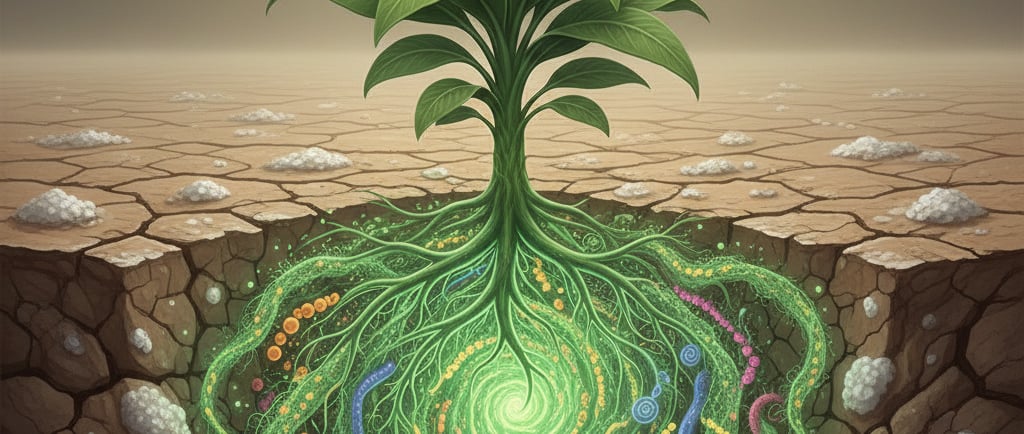
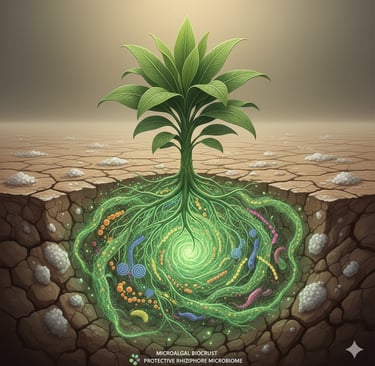
On their own, microalgae and plant growth-promoting bacteria (PGPB) are effective biofertilizers. But when they form a symbiotic partnership, their benefits are magnified. They create a self-sustaining ecosystem around the plant's roots where they help each other thrive, creating a powerhouse of plant support.
Think of it as a perfect trade:
The microalgae, through photosynthesis, produce oxygen and organic matter. This provides a vital source of energy and carbon for their microbial partners.
In return, the bacteria provide the microalgae with essential nutrients they can't get on their own, like fixed nitrogen, carbon dioxide from respiration, and even crucial vitamins.
This constant exchange allows the team to perform complex tasks that neither could do alone. This synergy doesn't just help the microbes; it directly translates into a healthier, more resilient environment for plant roots.
How the Algae-Microbe Duo Helps Plants Beat Salt Stress
This powerful partnership provides a multi-pronged strategy to help plants grow in salty soils:
Enhanced Nutrient Supply: Together, they unlock and provide a wider range of essential nutrients like nitrogen, phosphorus, and potassium, acting as a super-effective, living fertilizer.
Hormone Production: The team produces beneficial plant hormones (phytohormones) like auxins, which stimulate root growth, helping plants develop more extensive root systems to search for water and nutrients.
Improved Soil Structure: The substances they secrete, like polysaccharides, act like a natural glue, improving soil aggregation. This leads to better water retention and healthier soil that's less prone to erosion.
Disease Protection: This symbiotic system can stimulate the plant's own defense mechanisms and even secrete compounds that act like natural antibiotics, helping to ward off pests and diseases that can strike when plants are weakened by salt stress.
Studies have shown this teamwork in action. Co-inoculating wheat with the microalga Chlorella and nitrogen-fixing bacteria was far more effective at reducing salt stress than applying either one alone. Similarly, combining Spirulina algae with Pseudomonas bacteria synergistically boosted onion growth and yield in salty conditions.
Challenges and the Exciting Future
While the potential is huge, this isn't a simple magic bullet. The real world is complex; introduced algae and microbes might compete with native soil organisms, and not all strains work well together. The cost of cultivating and applying these consortia on a large scale is also a significant hurdle.
However, the future is incredibly bright. Scientists are using genetic engineering and "Synthetic Microbial Communities" (SynComs) to design optimized teams of microbes that are more resilient and effective. By understanding the intricate teamwork between microalgae and microbes, we can move from simple soil fixes to a more holistic approach of "systematic ecological engineering." It's a new frontier in creating sustainable, resilient agriculture that can thrive even on the challenging salty soils of our planet.