Add your promotional text...
Smart Farming for Your Backyard: The Future of Soil Nutrient Testing
Source & Further Information: The findings and concepts discussed in this article are largely based on the research presented in the following scientific paper: Postolache S, Sebastião P, Viegas V, Postolache O, Cercas F. IoT-Based Systems for Soil Nutrients Assessment in Horticulture. Sensors (Basel). 2022 Dec 30;23(1):403. doi: 10.3390/s23010403. PMID: 36617000; PMCID: PMC9823829. We encourage readers interested in the detailed methodology and complete results to consult the original publication.
2/25/20263 min read
Have you ever wondered if your plants are really getting the right food? For decades, the only way to truly know what was in your soil was to send samples to a lab for expensive and time-consuming tests. But what if you could get real-time insights into your garden's health, right from your phone? This isn't science fiction; it's the cutting edge of horticulture, where smart sensors and the Internet of Things (IoT) are coming together to create a new era of "precision agriculture."
The Challenge: Every Garden is Unique
Feeding our plants isn't as simple as just adding fertilizer. A huge challenge, especially in diverse gardens or small-scale horticulture (growing fruits, veggies, and flowers), is that soil is incredibly variable. One part of a farm might be hilly and drain quickly, while another is flat and retains water. Different plants have different appetites, taking up nutrients like Nitrogen (N), Phosphorus (P), and Potassium (K) at different rates.
Traditional methods often involve treating large areas uniformly, which can lead to over-fertilizing (wasting money and polluting water) or under-fertilizing (reducing yields). We need a smarter way to manage these resources.
Enter the Smart Sensor Solution
This is where new technology steps in. Researchers are developing low-cost, efficient information systems using a network of smart sensors. Imagine small, portable stations you can place directly in your garden bed. These "sensor nodes" are packed with technology to measure key soil parameters in real-time.
A recent study explored this very idea, developing and testing an IoT-based system designed to tackle the challenges of soil nutrient assessment. The goal? To create a system that could provide a clear picture of what's happening beneath the surface, helping gardeners and farmers make better decisions.
How it Works: A Peek Under the Hood
The system they built is a great example of modern "smart farming":
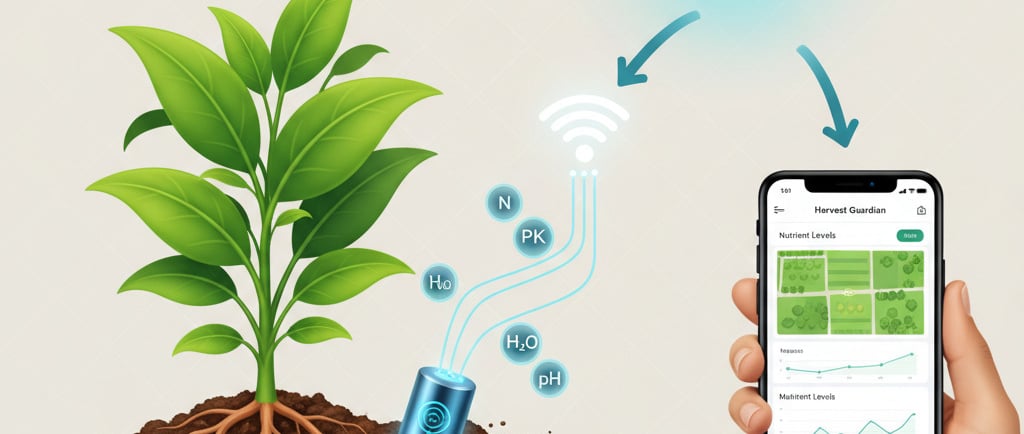
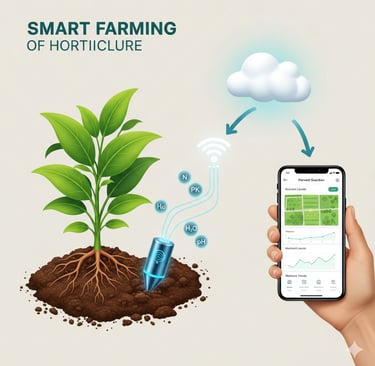
Smart Sensor Nodes: These are the heart of the system. Each node contains a sophisticated multi-channel sensor that is pushed directly into the soil. It doesn't just measure one thing; it simultaneously measures soil moisture, temperature, pH (acidity), electrical conductivity, and the crucial macronutrients: Nitrogen (N), Phosphorus (P), and Potassium (K). It also measures the air temperature and humidity nearby.
IoT Connectivity: Each sensor node is a mini-computer (using an ESP32 board, for tech enthusiasts) that processes the data and sends it wirelessly (using Wi-Fi in this study) to a central server in the cloud.
Mobile App: All this complex data is then presented in a user-friendly way on a mobile app. The app shows a map of the garden with the sensor locations. A user can tap on a location and see graphs of the current soil conditions, nutrient levels, and how they've changed over time.
Putting it to the Test: Insights from a Botanical Garden
To test their system in a challenging, real-world environment, the researchers deployed these sensor nodes throughout the diverse landscape of the Lisbon Tropical Botanical Garden. This location was a perfect stand-in for a complex horticultural farm, with varying slopes, different soil types, a wide variety of plants, and even lakes and streams.
They collected data before and after rainfall to see how the sensors responded. The results were fascinating and highlighted just how dynamic soil really is:
Rain Changes Everything: As expected, after it rained, soil moisture levels went up. But interestingly, this also caused the measured concentrations of N, P, and K to increase significantly in most places. This is likely because the nutrients, now dissolved in water, were more easily detected by the sensor. The electrical conductivity of the soil also increased, which is consistent with more dissolved ions (nutrients) in the water.
Location Matters: Sensors placed near lakes and streams consistently measured higher air humidity, showing the system's ability to detect local microclimates.
Temperature Stability: While air temperatures fluctuated significantly (from 21°C to 30°C), the soil temperature was much more stable, hovering around 20°C. This shows how soil acts as an insulator, protecting plant roots from extreme temperature swings.
The pH Puzzle: In most sites, the soil became slightly less acidic after the rain. However, the data also showed that the relationship between all these factors is complex. For example, the strong correlation between soil moisture and nutrient readings before the rain slightly weakened after the rain, underscoring the need to consider multiple factors (like soil texture and organic matter) for a complete picture.
The Future is Data-Driven Gardening
This research successfully demonstrates that low-cost, IoT-based systems can provide valuable, real-time data on soil health. The study highlights that just measuring NPK isn't enough; you need to measure it alongside moisture, pH, and conductivity to correctly interpret the results.
The dream is a future where gardeners and small farmers can use affordable, portable sensors like these to apply exactly the right amount of water and fertilizer, at exactly the right time, for each specific plant or plot. This "precision horticulture" would lead to healthier plants, higher yields, less waste, and a reduced environmental impact. While the technology is still evolving, this study provides a powerful glimpse into the future of smart, sustainable gardening.