Add your promotional text...
Soil is Our Treasure: Using Nanotechnology to Fight Degradation
Source & Further Information: The findings and concepts discussed in this article are largely based on the research presented in the following scientific paper: El-Ramady H, Brevik EC, Fawzy ZF, Elsakhawy T, Omara AE, Amer M, Faizy SE, Abowaly M, El-Henawy A, Kiss A, Törős G, Prokisch J, Ling W. Nano-Restoration for Sustaining Soil Fertility: A Pictorial and Diagrammatic Review Article. Plants (Basel). 2022 Sep 14;11(18):2392. doi: 10.3390/plants11182392. PMID: 36145792; PMCID: PMC9504293. We encourage readers interested in the detailed methodology and complete results to consult the original publication.
2/6/20263 min read
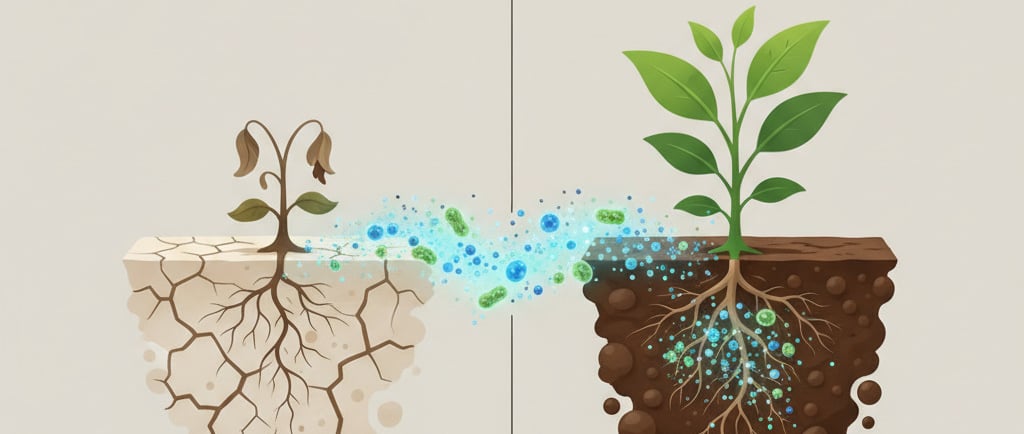
Our planet's soil is a treasure. It’s the foundation for our food, fibers, and even fuel. But this precious resource is in trouble. Across the globe, soils are suffering from degradation – a catch-all term for damage caused by pollution, salt buildup, erosion, and unsustainable farming practices. When soil degrades, it loses its fertility, its biodiversity, and its ability to support healthy crops. This puts our global food security at risk.
For years, we've fought back with methods like adding organic matter and beneficial microbes. But now, scientists are exploring a new, microscopic frontier: nano-restoration. This cutting-edge approach uses tiny, engineered particles – nanoparticles – to help clean up and revitalize our damaged soils.
The Problem: A World of Worn-Out Soil
To feed a projected 10 billion people by 2050, we need our farms to be more productive than ever. Yet, about 25% of our planet's soils are already seriously degraded. This isn't just one problem; it's a mix of issues:
Chemical Degradation: Buildup of salts (salinity) makes it hard for plants to absorb water. Pollution from industry and agriculture introduces toxic substances.
Physical Degradation: Soil gets compacted like concrete, preventing roots from growing and water from soaking in. Erosion washes away the fertile topsoil.
Biological Degradation: The bustling underground ecosystem of beneficial microbes dies off, and rich organic matter disappears, leaving the soil lifeless.
Restoring these soils is a critical part of achieving global goals like "Zero Hunger." But traditional methods can be slow. Can nanotechnology speed up the process?
The Promise of Nanotechnology: A Microscopic Toolkit
Nanotechnology involves working with materials at an incredibly small scale (a nanometer is one billionth of a meter). At this size, materials can have unique properties that make them powerful tools for environmental cleanup. "Green" synthesis methods even use plants and microbes to create these nanoparticles in an eco-friendly way.
In agriculture, this could mean:
Nano-fertilizers that deliver nutrients more efficiently to plant roots.
Nano-pesticides that target pests with greater precision.
Nano-remediation where nanoparticles are used to trap, break down, or neutralize pollutants in the soil.
For example, studies have shown that specific nanoparticles can help plants tolerate salty soils, improve nutrient availability in sandy soils, and even help clean up heavy metal contamination.
The Power Trio: Nanoparticles, Plants, and Microbes
The real magic happens when these tiny particles interact with the existing life in the soil. Scientists are increasingly focused on the "Nanoparticle–Plant–Microbe (NPM) nexus."
Think of the area around a plant's roots (the rhizosphere) as a bustling city. Plants release sugars and other compounds (root exudates) that feed a community of beneficial bacteria and fungi. These microbes, in turn, break down organic matter and unlock nutrients in the soil, making them available for the plant. It’s a powerful symbiotic relationship that is the very definition of soil fertility.
When nanoparticles are introduced, they become a new player in this bustling city. The hope is that they can supercharge the positive interactions:
Nanoparticles might help beneficial microbes do their job better.
They could deliver nutrients directly to where plants and microbes need them.
They can act as tiny sponges or catalysts to clean up pollutants that are harming both plants and microbes.
This complex, three-way interaction is at the heart of nano-restoration.
A Word of Caution: The Risks of Going Nano
While the potential is exciting, nano-restoration isn't a magic bullet. We're introducing engineered materials into a complex ecosystem, and we need to be careful. Scientists are actively studying the potential downsides, often called "nano-toxicity."
The concern is that the same properties that make nanoparticles effective could also cause harm. If over-applied, some nanoparticles have been shown to negatively affect soil microbes or even be absorbed by plants. If they accumulate in edible crops, they could enter the food chain, posing a potential risk to human health.
Therefore, a key part of the research is finding the right balance: using the right type of nanoparticle, at the right dose, for the right problem, and ensuring it's done in an environmentally safe way. A thorough risk-benefit analysis is essential before any new nano-formulation is widely used in agriculture.
The Future is Small, But the Questions are Big
Nano-restoration offers a promising new chapter in our quest to sustain soil fertility for a growing world. By understanding the intricate dance between nanoparticles, plants, and microbes, we may unlock powerful new ways to heal our degraded lands.
However, many questions remain. How do different nanoparticles behave in different soil types? What are the long-term ecological impacts? How can we best harness the power of the Nanoparticle-Plant-Microbe nexus without causing unintended harm? Answering these questions is the next great challenge for scientists working to protect our most valuable treasure: our soil.