Add your promotional text...
Straw vs. Biochar: Which is Better for Your Farmland?
Source & Further Information: The findings and concepts discussed in this article are largely based on the research presented in the following scientific paper: Chen L, Sun S, Yao B, Peng Y, Gao C, Qin T, Zhou Y, Sun C, Quan W. Effects of straw return and straw biochar on soil properties and crop growth: A review. Front Plant Sci. 2022 Sep 27;13:986763. doi: 10.3389/fpls.2022.986763. PMID: 36237511; PMCID: PMC9552067. We encourage readers interested in the detailed methodology and complete results to consult the original publication.
12/3/20253 min read
The Unsung Hero of the Harvest
After every harvest, vast amounts of crop straw—the stalks and leaves of plants like rice, corn, and wheat—are left behind. For a long time, this was seen as waste, often simply burned in the fields, creating air pollution. But what if this leftover straw is actually a hidden treasure? As we face challenges like soil degradation and nutrient loss, scientists and farmers are rediscovering an age-old practice with a modern twist: straw return. This sustainable method involves putting agricultural residues back into the earth, turning waste into a powerful tool for improving soil health and boosting crop growth.
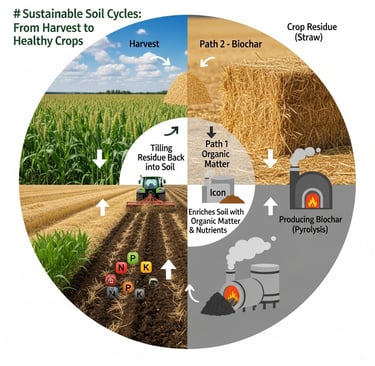
But how should we return it? The two main methods being explored are returning straw directly, and converting it into a stable, carbon-rich charcoal called biochar first. Let's look at how these different approaches impact the soil and the crops that depend on it.
Method 1: Direct Straw Return – The Natural Approach
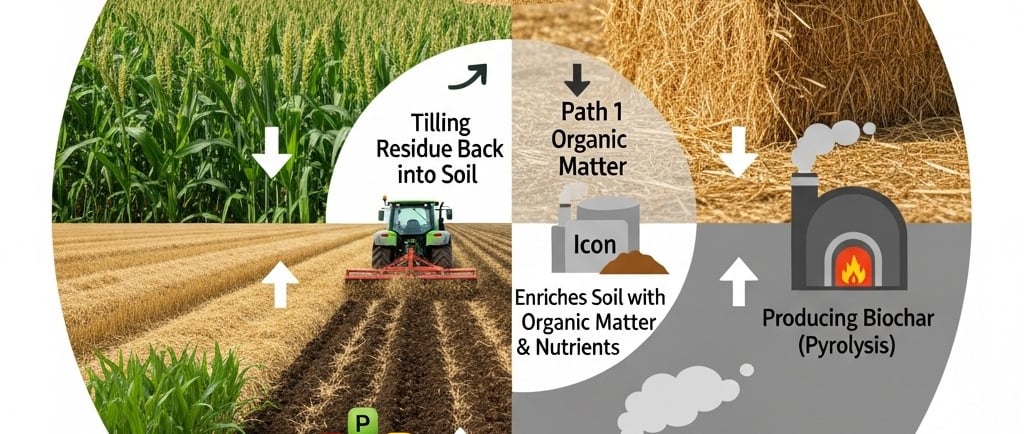
The simplest method is to chop up straw and mix it back into the soil. This approach has several proven benefits:
Boosting Soil Organic Carbon (SOC): Straw is rich in carbon. Returning it to the field directly increases the soil's carbon content, which is a cornerstone of healthy soil. Studies consistently show that fields with long-term straw return have significantly higher SOC levels than those where straw is removed. More SOC helps soil hold water, improves its structure, and feeds beneficial microbes.
Replenishing Nutrients: Straw isn't just carbon; it contains essential nutrients like nitrogen (N), phosphorus (P), and potassium (K) that plants need to grow. As the straw decomposes, these nutrients are slowly released back into the soil, acting like a natural slow-release fertilizer and reducing the need for synthetic fertilizers.
Happier Soil Microbes: Straw is a feast for soil microorganisms! Adding this organic matter provides food and energy for bacteria and fungi, which are vital for nutrient cycling and maintaining a healthy soil ecosystem. This often leads to increased soil enzyme activity, a key indicator of fertile, living soil.
However, direct straw return isn't always a perfect solution. Because straw is high in cellulose and lignin, it can decompose very slowly. This can sometimes temporarily tie up nitrogen in the soil as microbes work to break it down, and if not managed well, it can sometimes interfere with planting the next crop.
Method 2: Straw Biochar – The High-Tech Charcoal Treatment
What if we could make the benefits of straw last even longer? That's the idea behind biochar. By heating straw in a low-oxygen environment (a process called pyrolysis), it's transformed into a stable, porous charcoal. Adding this straw biochar to the soil has its own unique set of advantages:
Supercharged Carbon Sequestration: The carbon in biochar is incredibly stable and resistant to decomposition. This means adding it to soil is a powerful way to lock carbon away for the long term, helping to fight climate change.
Improving Soil Structure & Water Retention: Biochar's porous, sponge-like structure helps to aerate dense soils and improve water-holding capacity in sandy soils. It acts like a permanent soil conditioner.
Nutrient Magnet: Biochar can help hold onto nutrients in the soil, preventing them from being washed away by rain. This improves fertilizer efficiency and ensures more nutrients are available for plants when they need them.
Balancing Soil pH: Biochar is often alkaline, which can be beneficial for neutralizing overly acidic soils, creating a more favorable environment for many crops and microbes.
While biochar is a powerful soil amendment, its effects can depend heavily on the type of straw used, the temperature it was made at, and the soil it's added to. Sometimes, high application rates might not immediately boost crop yields until the biochar has had time to integrate with the soil.
The Ultimate Combo: Straw Biochar + Fertilizer
Research shows that the real magic often happens when these methods are combined with fertilizers (either organic, like manure, or mineral). Adding fertilizer provides an immediate nutrient boost for crops, while the straw or biochar improves the soil's underlying health and structure for the long term.
Combining biochar with fertilizer is particularly effective. The biochar helps hold onto the nutrients from the fertilizer, spoon-feeding them to the plant and reducing nutrient loss to the environment. This synergistic effect often leads to greater improvements in soil health and crop yields than using either one alone.
Conclusion: A Sustainable Future for Farming
Returning agricultural straw to the fields, whether directly or as biochar, is a vital strategy for sustainable farming. It closes the nutrient loop, builds soil carbon, reduces waste, and enhances the overall resilience of our agricultural ecosystems. While the best approach can vary depending on local conditions—like climate, soil type, and crop rotation—the evidence is clear: treating straw as a resource, not a waste product, is a crucial step towards ensuring healthy soils and food security for the future. Long-term studies will continue to refine these practices, but the principle of giving back to the soil is a lesson well worth remembering.