Add your promotional text...
The Biochar Boost: Fixing Sandy Soil and Increasing Crop Yields by 20%
Source & Further Information: The findings and concepts discussed in this article are largely based on the research presented in the following scientific paper: Bekchanova M, Campion L, Bruns S, Kuppens T, Lehmann J, Jozefczak M, Cuypers A, Malina R. Biochar improves the nutrient cycle in sandy-textured soils and increases crop yield: a systematic review. Environ Evid. 2024 Feb 22;13(1):3. doi: 10.1186/s13750-024-00326-5. PMID: 39294832; PMCID: PMC11376106. We encourage readers interested in the detailed methodology and complete results to consult the original publication.
10/31/20252 min read
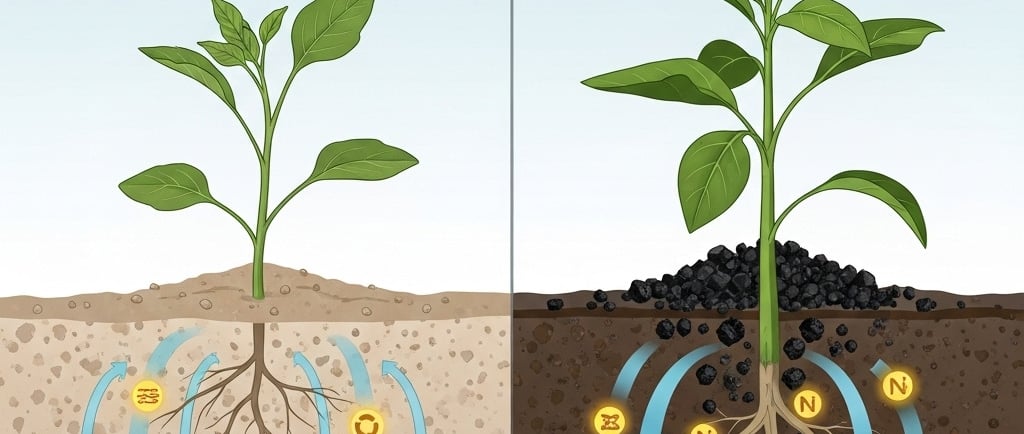
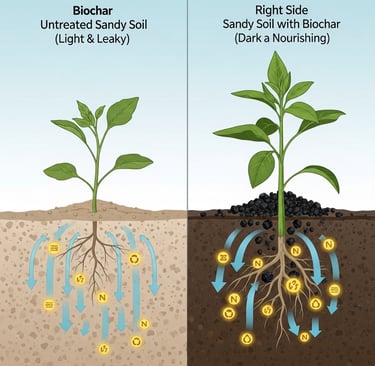
For farmers and gardeners, sandy soil can be a real headache. It’s like trying to grow plants in a sieve—water and vital nutrients just run right through. Covering 6% of the Earth's surface, these challenging soils often rely on heavy doses of fertilizer, which can be costly and environmentally damaging. But what if there was a way to fundamentally improve sandy soil, making it richer, healthier, and more productive? A growing body of research points to a powerful solution: biochar.
What is Biochar, and Why the Buzz?
Simply put, biochar is a special, nutrient-rich charcoal made by heating organic materials (like wood scraps, manure, or agricultural waste) at high temperatures with very little oxygen. It’s not new—ancient Amazonian cultures used it to create incredibly fertile "terra preta" soils—but it's now being rediscovered as a game-changing tool for modern sustainable agriculture.
The promise is huge: adding biochar to soil could help it hold onto water and nutrients, reduce the need for fertilizer, and even help fight climate change. However, scientific studies have shown mixed results, creating uncertainty. To get a clear answer, a team of researchers conducted a massive systematic review, sifting through over 1,600 observations from 92 different scientific studies to see what the overall evidence says about biochar’s effect on sandy soils.
The Verdict is In: Biochar Delivers Big Benefits
After analyzing all that data, the findings were overwhelmingly positive. On average, adding biochar to sandy-textured soils led to a cascade of impressive improvements:
More Nutrients in the Soil: The total amount of key nutrients—Nitrogen (N), Phosphorus (P), and Potassium (K)—in the soil increased by a whopping 36%. The amount of those nutrients readily available for plants to use also jumped by 34%.
Healthier, Well-Fed Plants: Nutrient levels within the plants themselves went up by 15%, showing they were successfully absorbing the richer supply.
Less Greenhouse Gas: Harmful nitrous oxide (N₂O) emissions from the soil, a potent greenhouse gas, dropped by a significant 29%.
Reduced Water Pollution: The leaching of mineral nutrients (where they wash out of the soil and can pollute groundwater) was cut by an incredible 38%.
Better Crop Yields: Most importantly for food security, the review found that food crop yields in sandy soils treated with biochar increased by a solid 20%!
In short, biochar acts like a sponge and a pantry for sandy soil. It helps the soil hold onto essential nutrients, prevents them from polluting the environment, and makes them available for plants to use, leading to better growth and bigger harvests.
The "It Depends" Factor: How to Get the Best Results
While the overall effect was positive, the review also highlighted that not all biochar applications are equal. The magnitude of the benefits often depended on a few key factors:
More is Often Better: Higher application rates of biochar generally led to stronger positive effects on nutrient levels and soil quality.
Location Matters: For reasons related to climate and local conditions, the benefits were found to be particularly strong in studies conducted in South America.
Soil Acidity (pH): The soil's starting pH also played a role, with different benefits appearing under different acidity levels.
This comprehensive review cuts through the uncertainty and provides a clear message: biochar is a powerful and effective tool for improving the nutrient cycle in challenging sandy soils. By boosting nutrient retention, reducing pollution, and significantly increasing crop yields, it stands out as a promising strategy for more sustainable and productive agriculture. For policymakers, farmers, and anyone looking to improve difficult soil, biochar is a solution worth serious consideration.