Add your promotional text...
The Cave's Hidden Treasure: Unlocking Microbial Superpowers for Our Soils
Source & Further Information: The findings and concepts discussed in this article are largely based on the research presented in the following scientific paper: Farda B, Djebaili R, Vaccarelli I, Del Gallo M, Pellegrini M. Actinomycetes from Caves: An Overview of Their Diversity, Biotechnological Properties, and Insights for Their Use in Soil Environments. Microorganisms. 2022 Feb 16;10(2):453. doi: 10.3390/microorganisms10020453. PMID: 35208907; PMCID: PMC8875103. We encourage readers interested in the detailed methodology and complete results to consult the original publication.
1/9/20263 min read
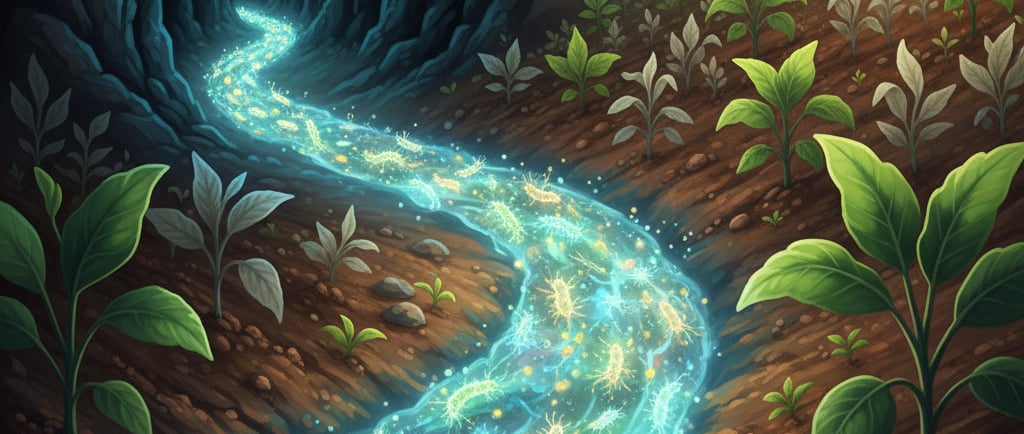
Deep beneath our feet, in the quiet, dark, and stable world of caves, lies a hidden treasure. It's not gold or gems, but a microscopic powerhouse: a group of bacteria called actinomycetes. For decades, scientists have been fascinated by these cave dwellers, discovering that they produce novel compounds that can fight cancer and kill superbacteria. But now, researchers are asking a new, exciting question: can these unique microbes be brought out of the dark to help solve some of our biggest problems above ground, like improving soil health, cleaning up pollution, and helping our crops thrive?
What Are Actinomycetes and Why Are Caves So Special?
Actinomycetes are a type of bacteria known for their incredible resilience. They form filament-like structures, similar to fungi, and can survive harsh conditions like high salinity, extreme pH, and drought. You’ve likely encountered them before without realizing it—they are partly responsible for the distinct, earthy smell of soil after it rains!
Caves provide a unique training ground for these microbes. The environment is stable but nutrient-poor, rich in specific minerals, and highly competitive. To survive, actinomycetes have evolved to become master chemists. They produce a vast arsenal of special compounds to outcompete their neighbors, break down minerals for food, and protect themselves. This evolutionary pressure cooker is why caves are a hotspot for discovering microbes with extraordinary abilities. Scientists are now hypothesizing that these highly adapted bacteria could be exactly what we need to improve our struggling soil environments.
From Cave Walls to Farmer's Fields: The Untapped Potential
The idea is to find these "allochthonous" (foreign) bacteria in caves, which have already passed nature's stress test, and apply them to agricultural or degraded soils. Imagine using a bacterium perfected in a high-alkaline cave to help plants access nutrients in alkaline farm soil! Researchers have identified three main areas where these cave microbes could make a massive difference:
1. Fighting Plant Diseases (Biocontrol):
With the rise of drug-resistant pathogens in both medicine and agriculture, the search is on for new antimicrobial weapons. Actinomycetes are famous for producing about two-thirds of all known antibiotics. While much research has focused on human medicine, these compounds can also be effective against plant pathogens (phytopathogens). Studies are beginning to show that metabolites from cave-dwelling Streptomyces (the most common actinomycete genus) can effectively inhibit fungi that cause rot in crops like corn. By producing these bioactive molecules, as well as compounds that steal essential iron from pathogens (siderophores), cave actinomycetes represent a promising, eco-friendly alternative to chemical pesticides.
2. Boosting Crop Growth (Biostimulation):
While direct studies are still few, the capabilities of actinomycetes from other environments are well-known. They act as Plant Growth-Promoting Bacteria (PGPB) through several mechanisms:
Nutrient Unlocking: They are experts at "mineral solubilization"—breaking down rock-hard minerals in the soil to release essential nutrients like phosphorus and potassium in a form plants can absorb.
Hormone Production: They can produce plant hormones like auxins, which stimulate root growth, helping plants develop more extensive root systems to find water and nutrients.
Nitrogen Fixation: Some can convert atmospheric nitrogen into a usable form, acting as a natural fertilizer.
By applying these multi-talented microbes to farm fields, we could potentially enhance crop productivity and reduce our reliance on synthetic fertilizers.
3. Healing Our Soils (Fertility & Remediation):
Many of our agricultural landscapes are threatened by salinization (high salt) and alkalinization (high pH). Caves, with their diverse mineral environments, are a great place to find microbes already adapted to these exact stresses.
Tackling Salty & Alkaline Soils: Halotolerant (salt-loving) actinomycetes from caves have evolved special mechanisms to survive in high-salt conditions. When applied to saline soils, they can help plants cope with the stress. Similarly, alkaliphilic (alkaline-loving) actinomycetes can thrive in high pH soils, helping to cycle nutrients and improve soil fertility where other microbes struggle.
Cleaning Up Pollution (Bioremediation): The unique metabolism of actinomycetes allows them to break down a shocking range of pollutants, including heavy metals, pesticides, herbicides, and petrochemicals. Strains of Streptomyces and Rhodococcus, for example, are known to tolerate and even metabolize harmful substances. The harsh, nutrient-limited cave environment may have supercharged these abilities, making cave actinomycetes ideal candidates for cleaning up contaminated industrial sites or agricultural land.
Building Better Soil (Bioconsolidation): In a fascinating twist, some actinomycetes found in cave formations like "moonmilk" (a soft, white deposit) play a role in biomineralization—they can actually encourage calcium carbonate to precipitate. This ability could be harnessed to naturally strengthen and consolidate loose or eroding soils, offering an eco-friendly alternative to chemical treatments.
The Road Ahead: Challenges and a Call for Research
Despite this incredible potential, the field of cave actinomycetes is still young. We can only cultivate a fraction of the species that exist, many remain unknown, and we need to be cautious about potential human pathogenicity in some strains.
However, the promise is undeniable. These cave-dwelling microbes are a vast, untapped resource of biological solutions. By encouraging more research into their unique abilities, we can unlock new eco-friendly tools to fight plant disease, improve crop yields, and heal our damaged soils, bringing the hidden superpowers of the underground into the light.