Add your promotional text...
The Comeback Crop: How Science is Rediscovering Cannabis
Source & Further Information: The findings and concepts discussed in this article are largely based on the research presented in the following scientific paper: Hussain T, Jeena G, Pitakbut T, Vasilev N, Kayser O. Cannabis sativa research trends, challenges, and new-age perspectives. iScience. 2021 Nov 1;24(12):103391. doi: 10.1016/j.isci.2021.103391. PMID: 34841230; PMCID: PMC8605354. We encourage readers interested in the detailed methodology and complete results to consult the original publication.
12/15/20252 min read
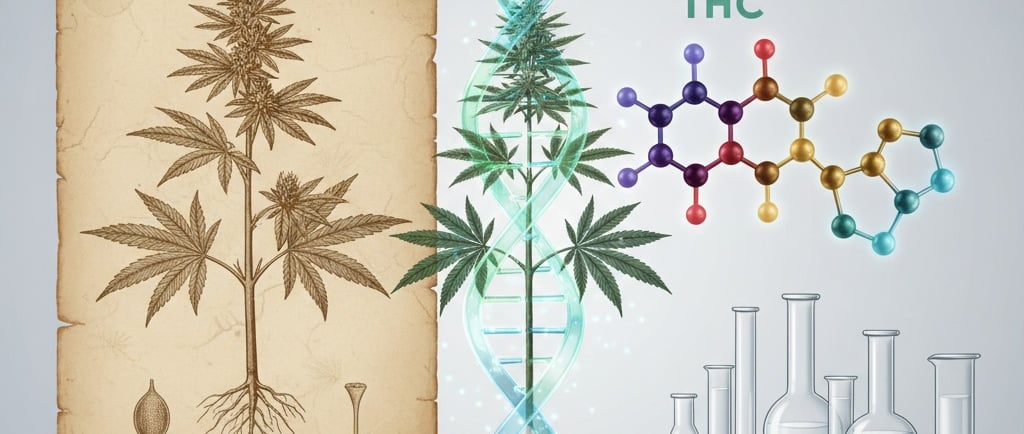
For 10,000 years, Cannabis sativa has been one of humanity's most versatile crops, used for everything from fiber and paper to traditional medicine. Yet, for much of the last century, its scientific potential was locked away due to controversy surrounding its psychoactive compounds. This is the story of cannabis's rollercoaster journey: from ancient herbal remedy to illicit drug, and now, back into the spotlight of cutting-edge science, fueled by legalization and powerful new technologies.
A History of Highs and Lows in Research
The scientific story of cannabis can be broken into distinct eras. Early reports from the 1840s praised its medicinal potential for treating serious ailments. However, as chemists began isolating its hundreds of compounds—most famously the non-psychoactive Cannabidiol (CBD) and the psychoactive Tetrahydrocannabinol (THC)—concerns grew. The discovery that THC interacts with our body's own endocannabinoid system, causing intoxicating effects, led to a global shift. Legal regulations tightened, and by the mid-20th century, the plant was largely recategorized as an illicit drug, severely stifling research for decades.
The turning point began in the 1960s with the full identification of THC and later, our body's cannabinoid receptors (CB1 and CB2). This sparked a new wave of scientific curiosity. But the real explosion in research came after 1996, when California's Compassionate Use Act opened the floodgates for medical cannabis legalization. In the last two decades alone, research has skyrocketed, with scientists exploring the incredible chemical diversity of the plant—from its hundreds of cannabinoids to its aromatic terpenes and beneficial flavonoids.
The Modern Science: From Plant Biology to Genomics
At the heart of the plant's chemistry are the glandular trichomes—tiny, crystal-like "factories" on the flowers and leaves where cannabinoids are produced. Inside these trichomes, a precursor molecule called CBGA (often called the "mother cannabinoid") is converted by specific enzymes into either THC or CBD. This simple-sounding switch is the fundamental difference between psychoactive "marijuana" and non-psychoactive "hemp," which are now legally distinguished by their THC content (hemp must be very low).
For years, understanding the genetics behind this switch was a major challenge. But the release of the first cannabis genome in 2011 changed everything. Modern sequencing technologies have now allowed researchers to map the DNA of numerous cannabis strains, from high-THC and high-CBD cultivars to wild varieties. Projects like the "1000 Cannabis Genomes Project" are creating a vast genetic atlas.
The goal? To move beyond guesswork and enable genomics-based breeding. By understanding the genes that control cannabinoid production, plant architecture, and disease resistance, scientists can help breed new cannabis varieties with precise chemical profiles tailored for specific medicinal uses—for example, plants with high concentrations of therapeutic CBD and almost zero THC.
New Frontiers: From COVID-19 to Commercial Patents
The renewed scientific interest has opened doors to surprising new applications. Recently, researchers have begun investigating the well-known anti-inflammatory properties of cannabinoids, especially CBD, for their potential to calm the "cytokine storm"—a severe and often fatal immune overreaction seen in serious COVID-19 cases. While this research is still in its early stages, it highlights the immense, untapped potential for drug discovery.
This potential has not gone unnoticed by industry. The number of cannabis-related patents has surged in the last decade, spanning everything from pharmaceutical preparations and drug delivery technologies to genetic sequences and plant breeding techniques. This commercial interest signals a definitive shift, transforming cannabis from a controversial plant into a major player in the modern pharmaceutical and agricultural industries.