Add your promotional text...
The Ultimate Upcycle: Using Supercritical CO₂ for Cannabis Extracts and Food Valorization
Source & Further Information: The findings and concepts discussed in this article are largely based on the research presented in the following scientific paper: de Aguiar AC, Vardanega R, Viganó J, Silva EK. Supercritical Carbon Dioxide Technology for Recovering Valuable Phytochemicals from Cannabis sativa L. and Valorization of Its Biomass for Food Applications. Molecules. 2023 May 1;28(9):3849. doi: 10.3390/molecules28093849. PMID: 37175258; PMCID: PMC10180460. We encourage readers interested in the detailed methodology and complete results to consult the original publication.
1/23/20263 min read
The world is waking up to the vast potential of the Cannabis sativa plant, not just for its well-known cannabinoids like CBD and THC, but as a source of sustainable products from medicine to food. But how do you get the good stuff out of the plant efficiently and safely? And what do you do with the rest of the plant? The answer might lie in a brilliant piece of green technology: Supercritical Carbon Dioxide (CO₂) extraction.
What is Supercritical CO₂ Extraction?
Imagine taking ordinary carbon dioxide (the same stuff that makes your soda fizzy), putting it under high pressure and temperature until it enters a unique "supercritical" state—somewhere between a liquid and a gas. In this state, CO₂ becomes a powerful and highly selective solvent. Supercritical Fluid Extraction (SFE) is the process of using this special CO₂ to gently and precisely pull valuable compounds out of plant materials.
Why is this a big deal? SFE is considered a "green" technology because:
It uses non-toxic, non-flammable CO₂ instead of harsh chemical solvents.
The CO₂ simply evaporates at the end, leaving behind a pure, solvent-free extract.
The CO₂ can be recycled and reused in the system, making it highly sustainable.
This method perfectly matches modern consumer demands for clean, natural, and sustainably produced extracts. It’s no wonder that interest in using SFE for cannabis processing has exploded in recent years.
Unlocking the Plant's Treasures: Cannabinoids & More
The Cannabis plant is incredibly complex, containing over 100 different compounds called phytocannabinoids. The two most famous are:
THC (Δ⁹-tetrahydrocannabinol): The compound responsible for the psychoactive "high."
CBD (Cannabidiol): A non-psychoactive compound praised for its potential therapeutic benefits, which can even moderate the effects of THC.
These compounds, along with others like terpenes (which give the plant its aroma) and flavonoids, interact with our body's endocannabinoid system (ECS). The ECS is a vast signaling network in our bodies that helps regulate everything from pain, mood, and memory to appetite and inflammation. Because cannabinoids from the plant can influence this system, they hold promise for treating a range of conditions.
While the science is still evolving, there's substantial evidence that cannabis-derived products can be effective for treating chronic pain, chemotherapy-induced nausea, and spasticity related to multiple sclerosis. Research into other areas like epilepsy and anxiety is also very promising. However, it's the non-psychoactive CBD that has gained significant attention for therapeutic use without the side effects associated with THC.
The Perfect Match: Using SFE to Extract Cannabis Compounds
SFE is an ideal method for processing cannabis. By carefully adjusting the temperature and pressure of the supercritical CO₂, operators can be incredibly selective. This "tunability" allows them to:
Target specific compounds: For example, setting conditions to maximize CBD extraction while minimizing THC.
Fractionate extracts: Separate different classes of compounds (like cannabinoids and terpenes) to create different products.
Handle decarboxylation: A gentle heating step (often done before or during SFE) activates the cannabinoids, converting them from their acid forms (CBDA, THCA) into their active forms (CBD, THC), which are more soluble in supercritical CO₂.
Studies have shown that SFE is one of the most effective and preferred methods for obtaining high-quality oils, cannabinoids, and volatile compounds from cannabis flowers, leaves, and seeds.
Beyond the Extract: Valorizing the Leftovers for Food
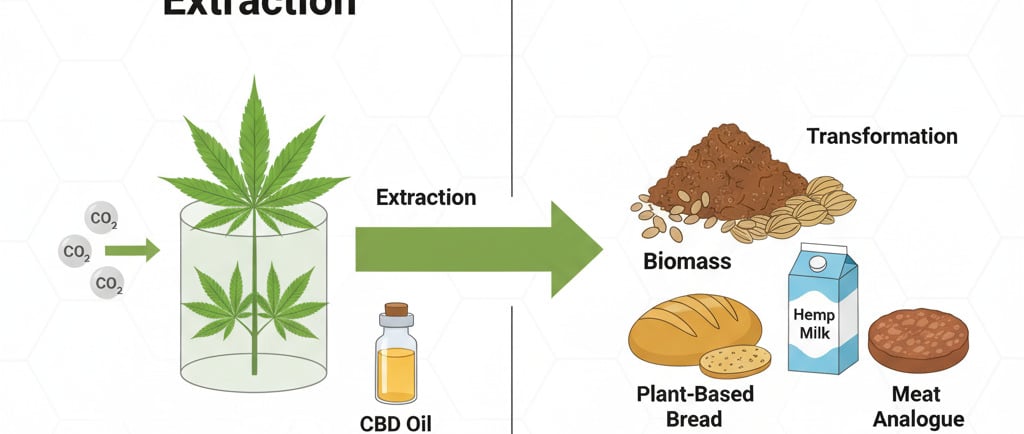
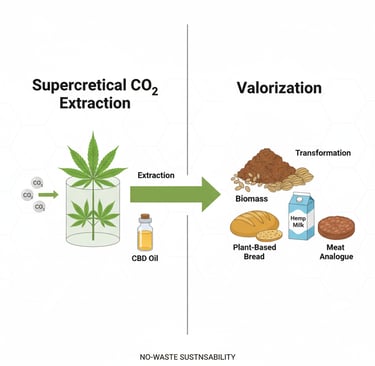
Here's where the story gets even more interesting. After SFE is used to extract the valuable CBD oil from industrial hemp (which has very low THC), what's left is a large amount of plant biomass—mostly seeds, stems, and leaves. Instead of treating this as waste, the "non-thermal" nature of SFE means this leftover biomass is still packed with nutritional value.
This opens the door for a "biorefinery" approach, where nothing is wasted:
Step 1: Use SFE to produce high-value CBD oil.
Step 2: Use the leftover hemp seed flour/protein as a nutritious ingredient for food applications.
Hemp seeds are a nutritional powerhouse, rich in protein, healthy fats (omega fatty acids), fiber, and minerals. Because SFE is a gentle process, it doesn't damage these valuable macronutrients. The resulting hemp flour and protein can be used to create:
Plant-based meat analogues: Replacing soy with hemp protein.
Fortified bakery products: Adding protein and fiber to bread and cookies.
Nutritious beverages: Creating hemp-based milk or fortifying yogurt-like drinks.
This integrated approach is the pinnacle of sustainability: creating high-value medicinal extracts and nutritious, plant-based food ingredients from the same crop, all using a clean, green technology.