Add your promotional text...
The Untamed Pantry: How Wild Plants Could Save Our Pampered Crops
Source & Further Information: The findings and concepts discussed in this article are largely based on the research presented in the following scientific paper: Renzi JP, Coyne CJ, Berger J, et al. How Could the Use of Crop Wild Relatives in Breeding Increase the Adaptation of Crops to Marginal Environments?. Front Plant Sci. 2022;13:886162. Published 2022 Jun 16. doi:10.3389/fpls.2022.886162. We encourage readers interested in the detailed methodology and complete results to consult the original publication.
10/8/20253 min read
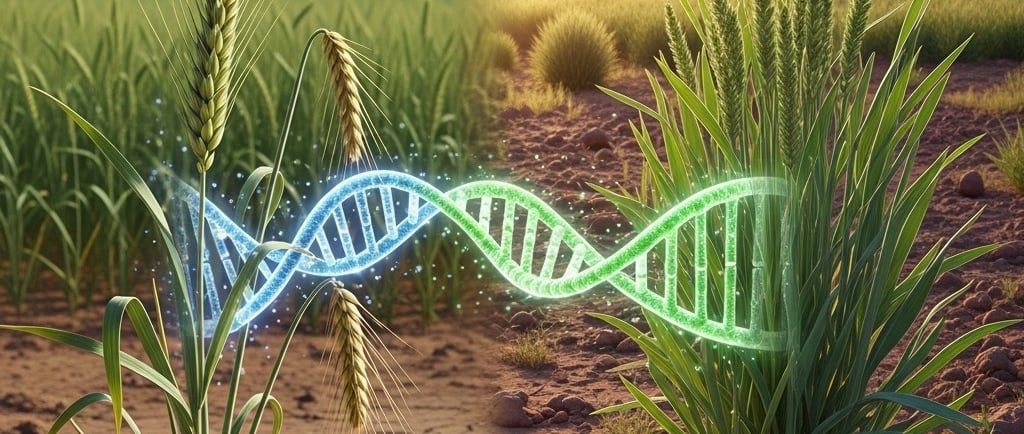
Modern crops are like highly-tuned race cars. On a perfect track—with fertile soil, plenty of water, and protection from pests—they deliver incredible performance and feed the world. But take them off-road into the real world of farming, especially onto what experts call "marginal lands," and they falter. These lands, plagued by poor soil, drought, and salinity, are expanding due to climate change, posing a direct threat to our global food security.
So, where do we find the rugged, all-terrain parts to upgrade our crops? The answer lies in their untamed ancestors: Crop Wild Relatives (CWRs).
The Survivalist vs. The Specialist: Why Wild Plants are Different
For thousands of years, wild plants have been engaged in a relentless battle for survival. They evolved under the harsh pressures of natural selection, competing for light, water, and nutrients while fending off pests and diseases. This forged them into resilient survivalists. They often invest heavily in strong roots and leaves, and employ clever strategies like seed dormancy—waiting for the perfect conditions to sprout to avoid a false start to the season. Their ultimate goal is long-term survival of their lineage.
In contrast, our modern crops have had a very different upbringing. Through domestication, we selected them not for survival, but for traits that benefit us: large seeds and fruits, loss of seed dormancy for uniform germination, and predictable ripening. We’ve turned them into specialists, optimized for maximum yield in a protected, high-input environment. This process, while boosting productivity, has created a "genetic bottleneck," stripping out much of the natural diversity that provides resilience. Our specialized crops are now vulnerable.
The Breeder's Toolkit: Borrowing Genes from the Wild
The challenge for scientists is clear: how do we transfer the incredible toughness of wild plants into our high-yielding crops without also bringing along undesirable traits like small seeds or low yield (a problem known as "linkage drag")? This is where "pre-breeding" comes in, using a toolkit that blends age-old techniques with cutting-edge technology.
The Classic Approach: Targeted Crossing
This is the traditional method. Breeders identify a wild relative with a desirable trait (like drought tolerance), cross it with an elite crop, and then painstakingly cross the offspring back with the elite crop over many generations. The goal is to keep the one "toughness gene" you want while getting rid of all the other unwanted wild genetics. It’s effective but can take many years.The Modern Upgrade: Genetic Mapping
Today, we can dramatically speed up the process. Using genomic tools, scientists can create a "map" of a plant's DNA and identify the specific regions associated with resilience. This allows breeders to use genetic markers to track the desired traits in the offspring, making the selection process much faster and more precise than just looking at the plants themselves.The High-Tech Solution: De Novo Domestication & Genome Editing
The most advanced tools, like CRISPR, allow for what is essentially "genetic surgery." Scientists can identify a toughness gene in a wild relative and precisely insert it into an elite crop. Even more exciting is the concept of de novo or "new" domestication: taking a wild plant that is already adapted to a marginal environment and using genome editing to quickly introduce key domestication traits (like larger seeds and non-shattering pods), effectively creating a brand new, resilient crop in a fraction of the time it took our ancestors.
The Genetic Library: Why Conservation is Key
This entire endeavor depends on one thing: having access to the wild relatives in the first place. These plants are a living library of genetic solutions, honed by millennia of evolution. Protecting them is paramount. This involves two key strategies:
Ex situ (Off-site) Conservation: Collecting and preserving seeds in secure genebanks around the world, like the Svalbard Global Seed Vault.
In situ (On-site) Conservation: Protecting the natural habitats where these wild relatives continue to evolve and adapt to changing conditions.
Without these conservation efforts, this invaluable genetic resource could be lost forever.
By looking back to the untamed origins of our food, and combining that ancient resilience with modern science, we have a powerful strategy to develop the tough, adaptable crops needed to feed our future on an ever-more challenging planet.