Add your promotional text...
Trash to Treasure: How Farm Waste is Being Turned into a Super-Filter for Pollution
Source & Further Information: The findings and concepts discussed in this article are largely based on the research presented in the following scientific paper: Ghosh S, Nandasana M, Webster TJ, Thongmee S. Agrowaste-generated biochar for the sustainable remediation of refractory pollutants. Front Chem. 2023 Nov 16;11:1266556. doi: 10.3389/fchem.2023.1266556. PMID: 38033473; PMCID: PMC10687200. We encourage readers interested in the detailed methodology and complete results to consult the original publication.
11/10/20253 min read
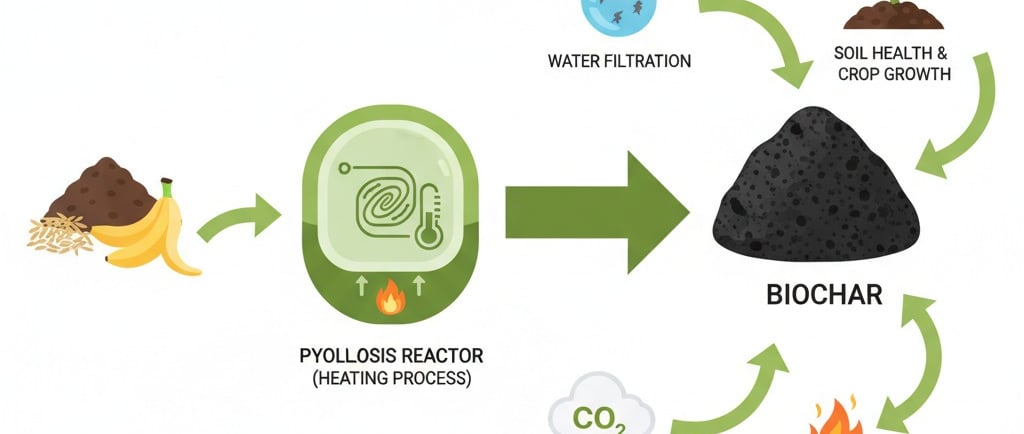
Our modern world has a pollution problem. From industrial dyes and heavy metals to pesticides and leftover pharmaceuticals, stubborn pollutants are contaminating our environment, posing a significant threat to ecosystems and our health. For years, we've relied on materials like activated carbon to help clean our wastewater, but it has its limits and costs.
What if the solution wasn't something we had to expensively manufacture, but something we could create from the millions of tons of waste we generate every year? A growing field of science is doing just that, transforming everyday agricultural waste—like rice husks, banana peels, and sugarcane bagasse—into a powerful, low-cost pollution-fighting tool called biochar.
What is Biochar? The Super-Charcoal from Farm Waste
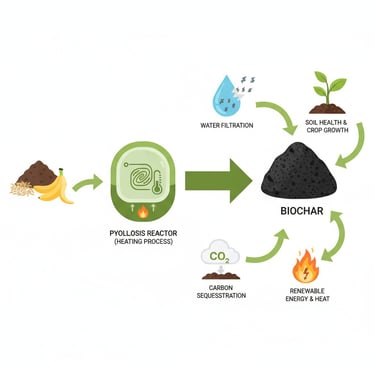
At its core, biochar is a special kind of charcoal. It’s made by taking biomass (plant matter, agricultural leftovers) and heating it to high temperatures (300°C–900°C) in a low-oxygen or oxygen-free environment, a process known as pyrolysis.
This process doesn’t just char the material; it fundamentally transforms it. The heat breaks down complex plant components like cellulose and lignin, leaving behind a highly porous, carbon-rich substance with an intricate, nanotextured surface. Think of it like a natural sponge, but on a microscopic level, with countless tiny pores and a massive surface area. This structure is what makes biochar an exceptional adsorbent—it’s incredibly good at grabbing and holding onto pollutant molecules.
The Super-Sponge at Work: Cleaning Up Stubborn Pollutants
The real power of biochar lies in its versatility. Researchers have tested its ability to remove a wide range of the environment's most difficult pollutants from water, with remarkable success.
Hazardous Dyes: Textile and other industries produce vibrant but often toxic dyes that are difficult to remove from wastewater. Studies show that biochar made from materials like banana peels and sugarcane bagasse can remove over 97% of certain hazardous dyes, effectively trapping the color molecules on its surface.
Heavy Metals: Toxic heavy metals like lead (Pb), chromium (Cr), and cadmium (Cd) are a major health concern. Biochar acts as a powerful filter for these metals. For example, biochar derived from avocado seeds and peels has demonstrated the ability to remove up to 99% of lead from a solution, while peanut husk biochar is highly effective at capturing chromium. The chemical groups on the biochar’s surface act like tiny magnets, binding to the metal ions and pulling them out of the water.
Pesticides & Pharmaceuticals: Leftover pesticides and pharmaceutical products are increasingly found in our waterways. Biochar offers a promising solution here too. Biochar made from coconut shells has been shown to remove over 98% of the pesticide diazinon, while various other agrowaste biochars are effective at adsorbing antibiotics like tetracycline and other drug residues.
PAHs (Polycyclic Aromatic Hydrocarbons): These are toxic organic compounds formed from burning fossil fuels and organic matter. Biochar, with its carbon-rich structure, has a natural affinity for these pollutants and can effectively trap them.
The secret to this success is a combination of physical trapping within its porous structure and chemical attraction via various functional groups on its surface. The process is often fast, efficient, and surprisingly simple.
More Than Just a Filter: The "Win-Win-Win" of Biochar
Cleaning up pollution is just one part of the biochar story. This remarkable material offers a cascade of environmental and economic benefits, creating a true circular economy solution.
Effective Waste Management: It provides a valuable purpose for agricultural waste (stubbles, husks, peels) that might otherwise be burned in fields—a practice that causes significant air pollution and greenhouse gas emissions.
Improving Soil Health: Biochar isn't just a filter; it's also a fantastic soil amendment. Adding it to soil can improve fertility, increase water retention (making soil more drought-resistant), and provide a stable habitat for beneficial microbes.
Carbon Sequestration: The process of creating biochar locks carbon into a very stable form. When this biochar is added to soil, that carbon can remain sequestered for hundreds or even thousands of years, effectively removing CO2 from the atmosphere and helping to combat climate change.
Renewable Energy: The gases and oils produced as byproducts during pyrolysis can be captured and used as biofuel, creating a source of renewable energy.
From cleaning our water to improving our soil and fighting climate change, biochar represents a powerful, multi-faceted approach to sustainability. By turning agricultural "waste" into a high-value resource, we can tackle some of our biggest environmental challenges in a way that is not only effective but also smart and circular.