Add your promotional text...
Unlocking Plant Potential: What Biostimulants Do and How "Metabolomics" Reveals Their Secrets
Source & Further Information: The findings and concepts discussed in this article are largely based on the research presented in the following scientific paper: Nephali L, Piater LA, Dubery IA, Patterson V, Huyser J, Burgess K, Tugizimana F. Biostimulants for Plant Growth and Mitigation of Abiotic Stresses: A Metabolomics Perspective. Metabolites. 2020 Dec 10;10(12):505. doi: 10.3390/metabo10120505. PMID: 33321781; PMCID: PMC7764227. We encourage readers interested in the detailed methodology and complete results to consult the original publication.
1/5/20263 min read
The Challenge: A Hungrier World on a Stressed Planet
Our food system faces a monumental challenge: feed a growing global population on land that is increasingly stressed by climate change and declining fertility. To meet this demand, we need innovative, sustainable ways to help our crops thrive. One of the most exciting frontiers in agriculture is the use of biostimulants.
What Exactly Are Biostimulants?
Think of biostimulants as a health tonic or personal trainer for plants. They aren't traditional fertilizers (nutrients), pesticides, or soil improvers. Instead, they are substances or beneficial microorganisms that, when applied to plants, kickstart their natural processes to:
Enhance growth and vigor.
Improve nutrient uptake and efficiency.
Increase tolerance to environmental stresses like drought, heat, or salinity.
The goal is to get a stronger, healthier, more productive plant by working with its own internal machinery. This could be a game-changer for sustainable and organic farming.
The "Black Box" Problem: We Know They Work, But How?
For a long time, the biostimulant industry has been based on observation: apply seaweed extract or beneficial bacteria, and often, the plant does better. But the why and how at a deep molecular level have often been a "black box." This lack of scientific understanding makes it hard to predict which biostimulant will work best on which crop, under which conditions, and makes it difficult to create consistent, reliable products. For biostimulants to truly revolutionize agriculture, we need to peek inside that black box.
Introducing "Metabolomics": Listening to the Chemical Language of Plants
This is where a powerful scientific field called metabolomics comes in.
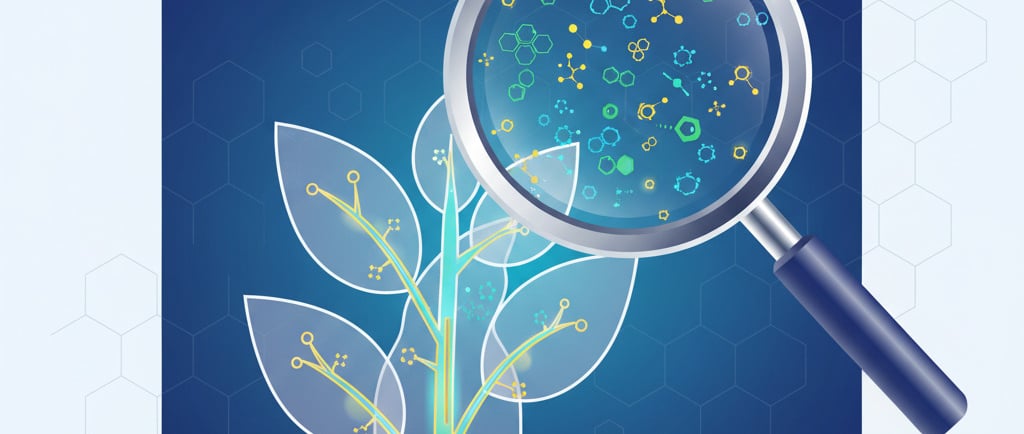
Imagine you could take a snapshot of every tiny chemical molecule—the metabolites—inside a plant cell at a specific moment. These thousands of molecules (sugars, amino acids, hormones, defensive compounds, etc.) make up the metabolome. The metabolome is the plant's real-time chemical language, revealing its current state of health, stress, and activity. It's more sensitive and immediate than looking at genes (genomics) or proteins (proteomics) alone.
By using metabolomics, scientists can "listen in" on this chemical conversation. They can compare the metabolome of a stressed plant with that of a stressed plant treated with a biostimulant. The differences in the chemical snapshot reveal exactly what the biostimulant is changing. Is it boosting antioxidant production? Is it changing hormone levels? Is it helping the plant manage its energy better?
Metabolomics allows scientists to move from simply saying "the plant looks better" to identifying the specific biochemical pathways the biostimulant is activating. This provides the hard scientific evidence needed to validate claims and design even better products in the future.
Plant Defenses: A Complex System
Plants are constantly under threat from pests and diseases (biotic stress) and harsh environmental conditions (abiotic stress). They've evolved a sophisticated, multi-layered defense system to cope.
Physical Barriers: Waxy cuticles and strong cell walls form the first line of defense.
Immune Response: When a threat gets past the barriers, plants can recognize "danger signals" from pathogens or from their own damaged cells. This triggers a complex immune response, much like in animals, involving hormone signaling, production of reactive oxygen species (ROS), and the creation of antimicrobial compounds to fight back.
Stress Memory ("Priming"): One of the most fascinating aspects is "priming." When a plant survives a mild stress, it can develop a kind of metabolic "memory." If that stress returns, the "primed" plant can launch a much faster and stronger defense response. Many biostimulants are believed to work by "priming" the plant, essentially preparing it for future challenges.
Metabolomics is the key to seeing these changes in action—identifying the specific "priming fingerprint" of metabolites that are stored in the plant's "stress memory."
The Future: A Scientifically-Driven Biostimulant Industry
The application of metabolomics to biostimulant research is still relatively new but incredibly promising. Studies have already used it to show how:
A protein hydrolysate biostimulant helped lettuce manage salt stress by increasing protective compounds.
A seaweed extract helped tomato plants by boosting their antioxidant enzymes.
Humic substances (from decomposed organic matter) helped activate root growth and defense pathways.
By decoding the mechanisms of action, metabolomics can help solve the biggest challenges in the biostimulant industry: defining what they are, characterizing their active ingredients, and providing a scientific basis for their claims. This leads to more reliable products for farmers and a more sustainable way to ensure our global food security in a changing climate.