Add your promotional text...
Unlocking the Language of Microbes for Sustainable Agriculture
Source & Further Information: The findings and concepts discussed in this article are largely based on the research presented in the following scientific paper: Chandrasekaran M, Paramasivan M, Sahayarayan JJ. Microbial Volatile Organic Compounds: An Alternative for Chemical Fertilizers in Sustainable Agriculture Development. Microorganisms. 2022 Dec 22;11(1):42. doi: 10.3390/microorganisms11010042. PMID: 36677334; PMCID: PMC9861404. We encourage readers interested in the detailed methodology and complete results to consult the original publication.
1/14/20263 min read
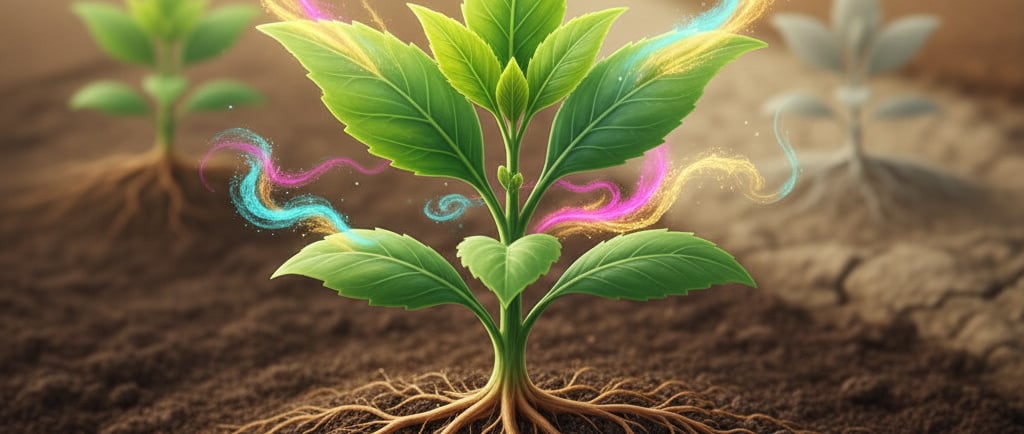

Imagine a vast, invisible conversation happening in the soil beneath our feet. Tiny microorganisms, like bacteria and fungi, are constantly releasing a complex cocktail of chemical scents. These aren't just random smells; they are a sophisticated language known as microbial volatile organic compounds (mVOCs). Scientists are now discovering that by learning to understand and harness this "microbe-speak," we might hold the key to a greener, more sustainable future for agriculture.
What Are mVOCs?
Simply put, mVOCs are low-weight, airborne chemical messengers produced by microbes during their daily life. Think of them like a microbe's unique scent profile. Because these compounds are "volatile," they easily evaporate and drift through the air and tiny pores in the soil. This makes them perfect for long-distance communication, not just between microbes, but also between microbes and plants.
The sheer diversity is staggering. What was once thought to be a small collection of chemicals is now known to be a vast library. Databases cataloging these scents have grown from around a thousand to nearly two thousand unique mVOCs from hundreds of different bacterial and fungal species. And the most exciting part? These invisible messages can have powerful, tangible effects on plants.
The Triple-Threat Benefits of Microbial Scents
The overuse of chemical fertilizers and pesticides has taken a toll on our environment and soil health, prompting a search for smarter, more natural alternatives—a "Green Revolution 2.0." mVOCs are emerging as a top contender, offering a powerful, three-pronged approach to helping plants thrive.
1. Potent Plant Growth Boosters:
Forget just adding nutrients to the soil; mVOCs can tell a plant how to grow bigger and stronger. Research has shown that plants exposed to certain mVOCs from beneficial bacteria like Bacillus subtilis experience remarkable changes. One of the first groundbreaking studies showed that Arabidopsis plants simply exposed to the "scent" of these bacteria grew larger leaves.
Specific compounds like 2,3-butanediol and acetoin have been identified as powerful growth promoters, increasing shoot biomass. Other mVOCs have been found to encourage longer roots, more lateral (side) roots, and even boost chlorophyll content, making plants more efficient at photosynthesis. It's like a puff of air is telling the plant, "Grow, thrive, reach for the sun!"
2. Natural Bodyguards & Biocontrol Agents:
One of the most promising uses for mVOCs is as a natural alternative to chemical pesticides. Many of these microbial scents are potently antifungal, antibacterial, or can even deter nematodes and insect pests.
How does it work? The mVOCs can directly inhibit the growth of harmful pathogens. Studies have shown mVOCs from Pseudomonas bacteria stopping the fungus that causes Sclerotinia stem rot, and those from Bacillus species reducing the severity of potato ring rot and tomato wilt. But there's more. These scents also act as an alarm system for the plant itself. Upon detecting certain mVOCs, a plant can trigger its own internal defense mechanisms—a process called Induced Systemic Resistance (ISR). The plant essentially "gets the message" that a threat is nearby and beefs up its defenses, ready to fight off an attack.
This biocontrol works not just in the field but also in storage. Certain mVOCs have been shown to protect harvested fruits, like cherries and peaches, from post-harvest molds and rot, offering a bio-fumigation solution.
3. Powerful Stress Relievers:
Beyond growth and defense, mVOCs can also help plants withstand environmental (abiotic) stresses like high salinity (salty soil) and drought. Although research in this area is newer, the results are exciting.
The famous mVOC 2,3-butanediol, for instance, has been shown to help plants tolerate both salty conditions and drought, partly by signaling leaf pores (stomata) to close to conserve water. Other mVOCs help plants manage their internal chemistry under stress, accumulating protective compounds like proline to prevent cellular damage. It’s like the microbial scent gives the plant a toolkit to better manage its internal water balance and protect itself from the harmful effects of a tough environment.
Challenges and the Future of "Scent Farming"
While the potential is immense, moving mVOCs from the lab to the field isn't a simple step. The production and effect of these compounds are influenced by many factors like soil type, temperature, pH, and the existing microbial community. A scent that works wonders in a petri dish might have a different effect in a complex field environment.
The future lies in overcoming these hurdles. Scientists are working on smart delivery systems and formulations to ensure a controlled release of these beneficial scents. The goal is to integrate this knowledge into modern farming, potentially using advanced sensors and data analytics to monitor and apply mVOCs precisely where they're needed.
Ultimately, mVOCs represent a paradigm shift. Instead of just feeding plants, we can use this invisible language of microbes to communicate with them—encouraging growth, activating defenses, and boosting resilience. It’s a cost-effective, eco-friendly approach that could play a vital role in securing our food supply for generations to come.