Add your promotional text...
Unlocking the Power of Biochar: A Secret Weapon for Soil Health
Source & Further Information: The findings and concepts discussed in this article are largely based on the research presented in the following scientific paper: Khan S, Irshad S, Mehmood K, Hasnain Z, Nawaz M, Rais A, Gul S, Wahid MA, Hashem A, Abd Allah EF, Ibrar D. Biochar Production and Characteristics, Its Impacts on Soil Health, Crop Production, and Yield Enhancement: A Review. Plants (Basel). 2024 Jan 8;13(2):166. doi: 10.3390/plants13020166. PMID: 38256720; PMCID: PMC10821463. We encourage readers interested in the detailed methodology and complete results to consult the original publication.
2/18/20263 min read
Our planet faces a double challenge: a rapidly growing population needing more food, and agricultural soils that are getting tired. The heavy use of chemical fertilizers and intensive farming has taken a toll, leaving our land less fertile and our farming practices unsustainable. But what if a solution could be found in something as ancient as charcoal? Enter biochar, a special type of charcoal that’s creating a buzz in the worlds of sustainable agriculture and climate science.
What Exactly is Biochar?
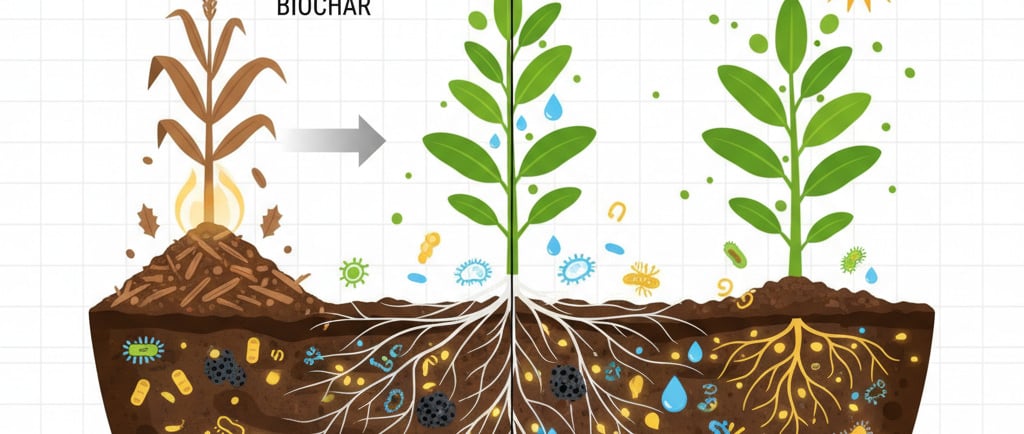
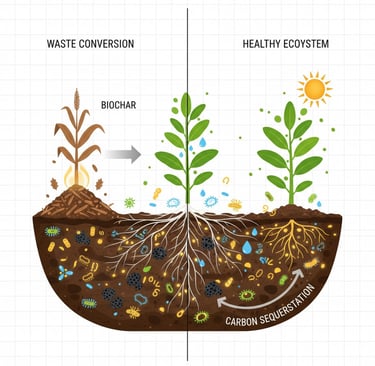
Imagine taking agricultural waste—like plant residues, wood scraps, or manure—and heating it to high temperatures in a low-oxygen environment. This process, called pyrolysis, prevents the material from simply burning to ash. Instead, it creates a stable, black, and incredibly porous carbon-rich material: biochar.
For the last decade, scientists have been intensely studying biochar's potential. It’s not just a soil additive; it’s a multi-purpose tool that can improve soil health, boost crop growth, clean up contaminants, and even help fight climate change by locking away carbon in the ground for the long term.
How Biochar Works its Magic on Soil
Think of a piece of biochar as a luxury high-rise apartment building for your soil. Its highly porous structure and unique surface chemistry give it several superpowers:
Acts Like a Sponge: Biochar’s countless tiny pores dramatically increase the soil's ability to hold onto water, making crops more resilient during dry spells.
Nutrient Magnet: It prevents essential nutrients from being washed away by rain (a process called leaching). Its surface can hold onto nutrients like a magnet, releasing them slowly to plant roots when needed.
Microbe Metropolis: The pores also provide a safe and stable home for beneficial soil microbes, fostering a vibrant underground ecosystem that is crucial for nutrient cycling and overall soil health.
Improves Soil Structure: It can reduce soil compaction, making it easier for plant roots to grow, and improves aeration.
Balances Soil pH: Biochar is often alkaline, which can help neutralize overly acidic soils and make nutrients more available to plants.
Numerous studies confirm these benefits, showing that adding biochar can improve a soil’s pH, water-holding capacity, nutrient levels, and microbial activity.
From Lab Pots to Farm Fields: The Real-World Picture
While the benefits sound amazing, scientists are working to understand how biochar performs in the real world. The "recipe" for biochar matters a lot—the type of waste used (feedstock) and the temperature of the pyrolysis process create biochars with very different properties. What works in one type of soil or climate might not work the same way in another.
Much of the early research was done in small-scale lab experiments. Now, more field trials are being conducted, and they generally show positive results, especially in degraded or nutrient-poor soils. For example:
Tropical Trials: In tropical regions, where heavy rains can quickly wash away nutrients, biochar has shown great promise. Field trials in the Philippines, Thailand, and Ghana resulted in significant maize and rice yield increases. In Indonesia, it helped improve soil chemistry and boosted the growth of maize and peanuts.
Temperate Regions: Studies in temperate climates have often shown positive or neutral effects, rarely negative ones.
Long-Term Effects: Some of the most exciting results show that biochar's benefits can increase over time. A study in Colombia found that while maize yield increased slightly in the first year after adding biochar, the increase jumped to 140% by the fourth year! This suggests that as biochar ages in the soil, it becomes even better at retaining nutrients.
Biochar's Role in a Greener Future: Regenerative Agriculture
Biochar fits perfectly into the goals of regenerative agriculture—a way of farming that aims to improve the land rather than degrade it. By enhancing soil health, reducing the need for chemical fertilizers, and sequestering carbon, biochar helps create a more sustainable and resilient farming system. It’s a powerful tool for improving soil fertility, boosting biodiversity, and storing carbon in the ground, all while helping to increase crop yields.
The Road Ahead
The science is clear: biochar holds immense promise. However, more long-term field studies are needed across different climates and soil types to create best-practice guidelines for farmers. The goal is to optimize biochar production and application to unlock its full potential for improving soil, securing our food supply, and contributing to a healthier planet.