Add your promotional text...
Want Safer Food & Healthier Soil? Meet the Microbes Making It Happen
Source & Further Information: The findings and concepts discussed in this article are largely based on the research presented in the following scientific paper: Daniel AI, Fadaka AO, Gokul A, Bakare OO, Aina O, Fisher S, Burt AF, Mavumengwana V, Keyster M, Klein A. Biofertilizer: The Future of Food Security and Food Safety. Microorganisms. 2022 Jun 14;10(6):1220. doi: 10.3390/microorganisms10061220. PMID: 35744738; PMCID: PMC9227430. We encourage readers interested in the detailed methodology and complete results to consult the original publication.
1/12/20263 min read
Our global family is growing. With nearly 8 billion people today and a projected 10 billion in the coming decades, the demand for food is skyrocketing. For years, the answer has been a heavy reliance on chemical fertilizers, pesticides, and herbicides. While these have boosted crop yields, they've come at a steep cost to our environment and our health. Is there a better, safer way to ensure everyone has enough to eat? The answer might lie in an army of microscopic allies already living in the soil: biofertilizers.
The Problem with Our Current Approach
To keep up with food demand, we've pushed our farmlands to their limits, often stripping them of natural nutrients. To compensate, we've used synthetic fertilizers packed with nitrogen, phosphorus, and potassium. But too much of a good thing can be harmful.
Overuse of chemical fertilizers can lead to:
Weakened Plants & Soil Damage: Making crops more prone to disease and increasing soil acidity.
Water Contamination: Excess nutrients, like nitrates, can leach into groundwater. This not only pollutes our water bodies (a process called eutrophication) but can also pose direct health risks, such as "blue baby syndrome" in infants.
Unsafe Food: Studies show that harmful pesticide residues can remain in our food long after it leaves the farm.
Clearly, this approach isn't sustainable for future generations. The search for a safer, more eco-friendly solution has led researchers back to nature's own wisdom.
Introducing Biofertilizers: Nature's Growth Promoters
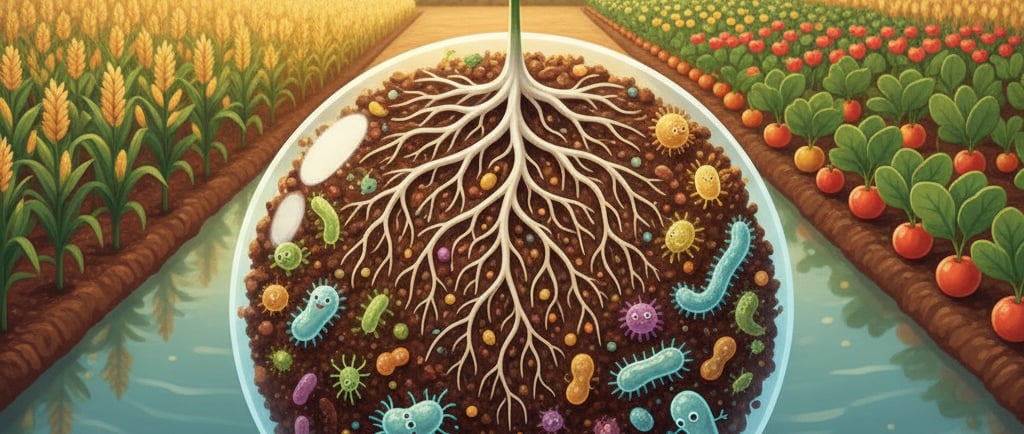
So, what are biofertilizers? They are essentially organic products containing beneficial microorganisms—like bacteria, fungi, and algae—that support plant growth. When applied to seeds, soil, or plants, these microbes colonize the area around the roots (the rhizosphere) or even live inside the plant itself.
Instead of force-feeding the plant with synthetic chemicals, biofertilizers work by enhancing the natural processes already present in the soil. They are a cost-effective, eco-friendly way to:
Boost Nutrient Uptake: Unlocking nutrients in the soil and making them available for plants to absorb.
Increase Crop Yields: Studies show they can increase yields by 10-40%!
Improve Plant Health: Enhancing a plant's tolerance to stresses (like drought) and its resistance to diseases.
Enhance Soil Fertility: Over time, continuous use actually improves the long-term health and fertility of the soil, a benefit chemical fertilizers often can't claim.
How Do These Microbes Work Their Magic? (The Mechanisms)
These tiny organisms have a sophisticated toolkit for helping plants. They can be broadly grouped by their primary functions:
Nitrogen-Fixers: Nitrogen is essential for plant growth, but the abundant nitrogen in our atmosphere is unusable by plants directly. Certain bacteria and algae are masters of "nitrogen fixation"—they can capture atmospheric nitrogen and convert it into ammonia, a form plants can readily use. This is one of the most critical functions of biofertilizers.
Phosphate & Potassium Solubilizers: Soil is often rich in phosphorus and potassium, but much of it is locked up in insoluble forms. Specific bacteria and fungi produce weak acids that dissolve these compounds, "unlocking" these vital nutrients and making them available to the plant's roots.
Plant Growth-Promoting Rhizobacteria (PGPR): This is a broad category of bacteria that live around roots and help plants in numerous ways. They can:
Produce Phytohormones: Synthesize plant hormones like auxin, which stimulates root growth, allowing the plant to explore more soil for water and nutrients.
Sequester Iron: Release special molecules called siderophores that bind to iron in the soil, making this essential micronutrient available to the plant while starving out potential pathogens.
Provide Indirect Protection: Some PGPR can outcompete harmful microbes or produce compounds that suppress plant diseases, acting as a natural defense system. This is known as "Induced Systemic Resistance" (ISR), essentially boosting the plant's own immune response.
After just a few years of use, the population of these beneficial microbes can become self-sustaining in the soil, reducing the need for repeated applications.
The Bigger Picture: Food Security & Food Safety
"Food security" means everyone has consistent access to enough safe and nutritious food. By enhancing crop yields sustainably, biofertilizers directly address this. But just as important is "food safety." By reducing or eliminating the need for harmful chemical pesticides and excess fertilizers, biofertilizers help produce food that is safer for us to consume, free from dangerous residues.
The Future is Microbial
The relentless rise in global population means we cannot afford to rely on unsustainable agricultural practices. Over-dependence on chemical fertilizers is costly, damaging to the environment, and a risk to our health.
Biofertilizers offer a promising path forward. They represent a shift from chemical intervention to biological partnership, working with nature's systems instead of against them. As we continue to discover and understand these powerful microorganisms, they will undoubtedly play a crucial role in building a future where we can produce enough safe, healthy food for everyone while protecting the long-term health of our planet.